

Florence Program Concentrations
- Concentration Overview: Examine the connections between food systems, cultural heritage, and sustainability in the birthplace of the Slow Food Movement. Students explore culinary traditions, ethical consumerism, and sustainable development, paired with field visits to local producers. The program equips students to analyze how food culture shapes communities and influences global policy.
- Core Courses (6 credits)
- Electives (choose 2–3 for semester / 1 for summer)
- Sustainable Urban Planning: Case Studies
- Eco-Tourism & Conservation in Natural Reserves
- Sustainable Fashion: Ethical Design & Production
- Circular Economy: Local Practices & Global Implications
- The Politics of Sustainability: Policies & Governance
- Sustainable Energy Systems: Transition to Renewable Energy
- Sustainability & Heritage: Balancing Preservation with Environmental Challenges
- Language
- Concentration Overview: Based in one of the world’s fashion capitals, this program blends design innovation with circular economy practices. Students study sustainable fashion, ethical production, and material innovation while exploring recycling initiatives and eco-conscious business models. The program prepares students to assess the social and environmental impact of the global fashion industry.
- Core Courses (6 credits)
- Electives (choose 2–3 for semester / 1 for summer)
- The Slow Food Movement: Sustainability & Tradition in Culinary Culture
- Sustainable Urban Planning: Case Studies
- Eco-Tourism & Conservation in Natural Reserves
- The Politics of Sustainability: Policies & Governance
- Sustainable Energy Systems: Transition to Renewable Energy
- Sustainability & Heritage: Balancing Preservation with Environmental Challenges
- Language
- Concentration Overview: Focused on sustainable cities, this program introduces students to urban planning, green architecture, and renewable energy systems. Through case studies and field visits, students analyze how historic cities balance heritage with climate resilience. Coursework emphasizes innovative solutions to air quality, mobility, and sustainable development challenges.
- Core Courses (6 credits)
- Electives
- The Slow Food Movement: Sustainability & Tradition in Culinary Culture
- Eco-Tourism & Conservation in Natural Reserves
- Sustainable Fashion: Ethical Design & Production
- Circular Economy: Local Practices & Global Implications
- The Politics of Sustainability: Policies & Governance
- Sustainability & Heritage: Balancing Preservation with Environmental Challenges
- Language
- Concentration Overview: Students investigate how governance shapes environmental outcomes, with emphasis on the EU’s Green Deal and international climate policy. Courses cover renewable energy policy, environmental justice, and sustainable development strategies. The program cultivates critical insight into the political frameworks driving global sustainability initiatives.
- Core Courses (6 credits)
- Electives
- The Slow Food Movement: Sustainability & Tradition in Culinary Culture
- Sustainable Urban Planning: Case Studies
- Eco-Tourism & Conservation in Natural Reserves
- Sustainable Fashion: Ethical Design & Production
- Circular Economy: Local Practices & Global Implications
- Sustainable Energy Systems: Transition to Renewable Energy
- Sustainability & Heritage: Balancing Preservation with Environmental Challenges
- Language
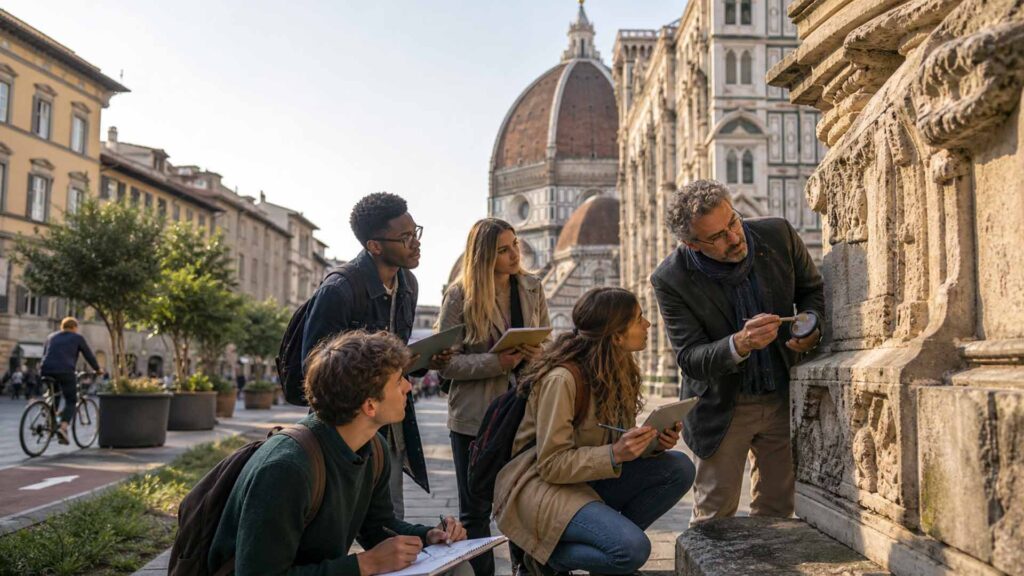
- Concentration Overview: Florence’s rich cultural heritage serves as a living classroom to study the intersection of preservation and sustainability. Students explore how communities balance tourism, climate pressures, and conservation while safeguarding historic and artistic treasures. The program integrates site visits with analysis of UNESCO practices and community-led preservation models.
- Core Courses (6 credits)
- Electives
- The Slow Food Movement: Sustainability & Tradition in Culinary Culture
- Sustainable Urban Planning: Case Studies
- Sustainable Fashion: Ethical Design & Production
- Circular Economy: Local Practices & Global Implications
- The Politics of Sustainability: Policies & Governance
- Sustainable Energy Systems: Transition to Renewable Energy
- Language
- Concentration Overview: This program highlights the transition to renewable energy and the role of innovation in shaping sustainable futures. Students engage in project-based learning on social entrepreneurship, paired with coursework on renewable energy systems and circular business models. The program fosters applied problem-solving skills in energy policy and technological innovation.
- Core Courses (6 credits)
- Electives
- The Slow Food Movement: Sustainability & Tradition in Culinary Culture
- Sustainable Urban Planning: Case Studies
- Eco-Tourism & Conservation in Natural Reserves
- Sustainable Fashion: Ethical Design & Production
- Circular Economy: Local Practices & Global Implications
- The Politics of Sustainability: Policies & Governance
- Sustainability & Heritage: Balancing Preservation with Environmental Challenges
- Language
Course Syllabi
Florence Courses
Studying sustainability presents an exciting opportunity to blend global environmental challenges with unique socio-cultural, historical, and environmental contexts. Learn in a country rich in natural landscapes, cultural heritage, and regional diversity, which offers numerous possibilities for exploring sustainability from various angles.
LOCATION
TERM
THEME
DISCIPLINE
 Core Course
- 45 Hrs
- 3 Credits
- No Prereqs
 Core Course
- 45 Hrs
- 3 Credits
- No Prereqs
 Elective Course
- 45 Hrs
- 3 Credits
- No Prereqs
 Elective Course
- 45 Hrs
- 3 Credits
- No Prereqs
 Elective Course
- 45 Hrs
- 3 Credits
- No Prereqs
 Elective Course
- 45 Hrs
- 3 Credits
- No Prereqs
 Elective Course
- 45 Hrs
- 3 Credits
- No Prereqs
 Elective Course
- 45 Hrs
- 3 Credits
- No Prereqs
 Elective Course
- 45 Hrs
- 3 Credits
- No Prereqs
 Elective Course
- 45 Hrs
- 3 Credits
- No Prereqs
 Elective Course
- 45 Hrs
- 3 Credits
- No Prereqs
 Elective Course
- 45 Hrs
- 3 Credits
- No Prereqs
 Elective Course
- 45 Hrs
- 3 Credits
- No Prereqs
 Elective Course
- 45 Hrs
- 3 Credits
- No Prereqs
 Elective Course
- 45 Hrs
- 3 Credits
- No Prereqs
Curriculum
School of Record:
Authentica courses are transcripted by our School of Record, Florida Agricultural & Mechanical University (FAMU).
Carnegie Rule:
Authentica follows the 2:1 Carnegie Rule for outside-of-class work: students are expected to spend roughly two hours studying and completing assignments out of class for every hour spent in class.
Summer (6 credits)
- Innovation in Action: Project-Based Learning - 3 credits
- Sustainable Development in Context: Italy - 3 credits
Semester (12-15 credits)
- Innovation in Action: Project-Based Learning - 3 credits (Required)
- Sustainable Development in Context: Italy - 3 credits (Required)
- Language & Electives - 6-9 credits
Course Descriptions
The United Nations Sustainable Development Goals (UN SDGs) offer a roadmap for a global future that promotes human flourishing and healthy ecosystems. They are multidisciplinary in nature, spanning human rights, public health, education, gender, economics, energy, urban design, and ecology. Though the SDGs are global in their aim and vision, how they are engaged and achieved varies according to national and regional factors. Using Florence as classroom and case study, this course examines the aspirations and realities of the UN SDGs through the lens of Italy and the greater European context. Through lectures, field visits, and project work, students engage deeply with both theoretical frameworks and practical applications related to sustainable development, developing their analytical, research, and practical problem-solving skills and preparing them to engage effectively with the global sustainability agenda.
Innovation in Action: Project-Based Learning (PBL) is a hands-on course designed to explore the emerging field of social entrepreneurship and innovation while fostering creativity, critical thinking, and problem-solving skills. This course will provide a comprehensive overview of how innovation drives sustainable and impactful solutions to social and environmental problems. Through real-world, team-based projects, students will engage with innovation in three essential contexts: the public, private, and citizen sectors, social enterprises (nonprofit, for-profit, and hybrid models), and social transformation across entire systems. Students will have the opportunity to apply theories and methodologies learned through prior coursework and their experience abroad, developing practical solutions that foster social change on local, national, and international levels.
Electives
Studying sustainability in Italy presents an exciting opportunity to blend global environmental challenges with Italy’s unique socio-cultural, historical, and environmental contexts. Italy is a country rich in natural landscapes, cultural heritage, and regional diversity, which offers numerous possibilities for exploring sustainability from various angles. Below are sustainable course ideas that are specifically tailored to Italy’s context
This course explores the Slow Food Movement, which began in Italy in 1986, focusing on the principles of sustainability, local food traditions, and ethical consumerism. Students will examine how Slow Food promotes good, clean, and fair food, emphasizing the preservation of local agricultural practices, biodiversity, and the cultural significance of food. Through lectures, field visits, and interactions with local producers, students will learn about the movement’s impact on food systems in Italy and its global influence.
Key Topics:
- Origins and philosophy of Slow Food
- Slow Food’s impact on sustainability, local economies, and food production
- The preservation of Italy’s culinary traditions and regional cuisines
- The role of Slow Food in food policy and global food movements
- Challenges and opportunities for Slow Food in the modern world
Learning Outcomes:
By the end of the course, students will gain a deeper understanding of how the Slow Food Movement connects sustainability, culture, and community, and how it influences both local and global food systems.
This course will focus on how Italian cities such as Milan, Bologna, and Florence are integrating sustainability into urban planning, transportation, and green building practices. Students will examine real-world case studies of how Italian cities are addressing issues like air quality, waste management, and sustainable tourism.
Key Topics:
- Green architecture and eco-friendly design in Italian cities
Sustainable transportation systems in Milan and Rome - Urban regeneration and smart city initiatives
- Managing tourism impacts in historic cities
- The role of Italian municipalities in climate resilience
Fieldwork:
- Walking tours of eco-friendly urban projects
With its rich biodiversity and national parks, Italy is a hotspot for eco-tourism. This course will dive into the intersection of sustainable tourism and environmental conservation in Italy’s protected areas, such as the Dolomites, the Cinque Terre, and the National Parks of the Italian Alps. Students will explore how eco-tourism can help preserve these natural treasures while benefiting local communities.
Key Topics:
- Principles of eco-tourism and sustainable travel
- Conservation efforts in Italy’s natural parks
- Balancing tourism growth with environmental protection
- Community engagement in sustainable tourism initiatives
- The impact of climate change on Italy’s natural habitats
Fieldwork:
- Study visits to national parks and eco-tourism villages.
Course Description:
Italy is a global leader in fashion, but the industry also faces increasing pressure to address environmental and social sustainability. This course will explore how Italian fashion houses and small artisans are adapting to sustainability trends through ethical production, sustainable materials, and eco-conscious consumerism.
Key Topics:
- Sustainable fashion trends in Milan and Florence
The role of Italy’s luxury brands in environmental and social responsibility
Materials innovation in Italian fashion - Slow fashion vs. fast fashion
- The impact of textile waste on the environment
Fieldwork:
- Visits to sustainable fashion brands or artisan workshops in Florence.
This course will explore the principles of the circular economy, focusing on how Italy is applying these principles in industries ranging from manufacturing to waste management. Italy has been a leader in circular practices, particularly in cities like Milan, which hosts a global summit on the circular economy. Students will analyze the economic, social, and environmental impacts of circular business models in Italy.
Key Topics:
- Introduction to the circular economy model
- Case studies of circular economy initiatives in Italy (e.g., fashion, plastic recycling)
- The role of Italian design in circular product development
- Circular economy in the food and beverage sectors
- Policy frameworks for promoting circularity in Italy
Fieldwork:
- Visits to recycling plants or businesses with circular models.
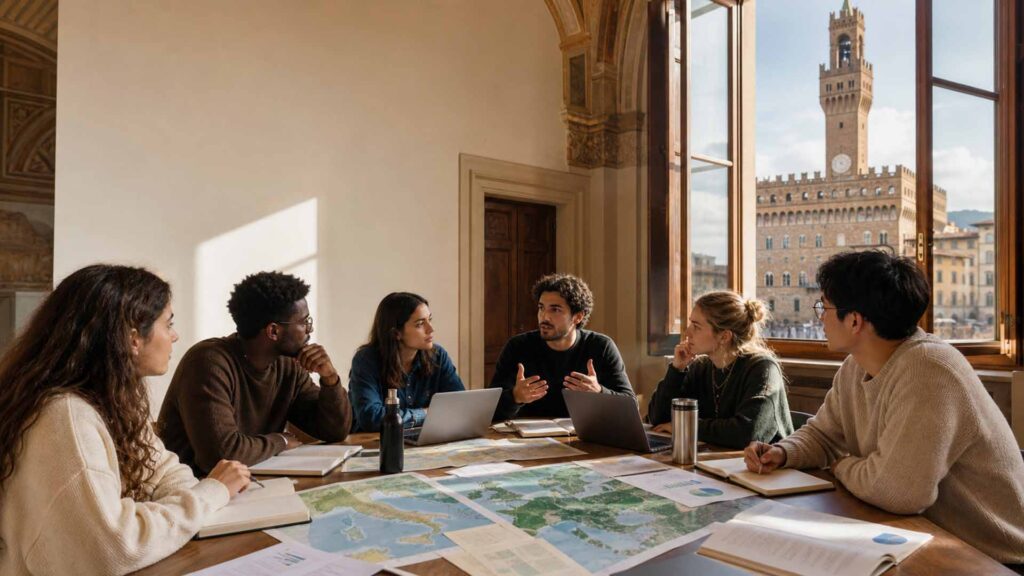
This course will delve into the political aspects of sustainability in Italy, examining how local, regional, and national governments are creating policies to address climate change, environmental protection, and sustainable development. Students will study Italy’s role in the European Union’s Green Deal and its influence on global environmental policies.
Key Topics:
- Italy’s role in the European Union’s sustainability agenda
- Government policies on climate change, renewable energy, and carbon emissions
- The Italian approach to environmental justice and social equity
- Green public procurement and government-led sustainability projects
- The intersection of politics and sustainability in local regions (e.g., Lombardy’s green initiatives)
Fieldwork:
- Meetings with policymakers and environmental NGOs.
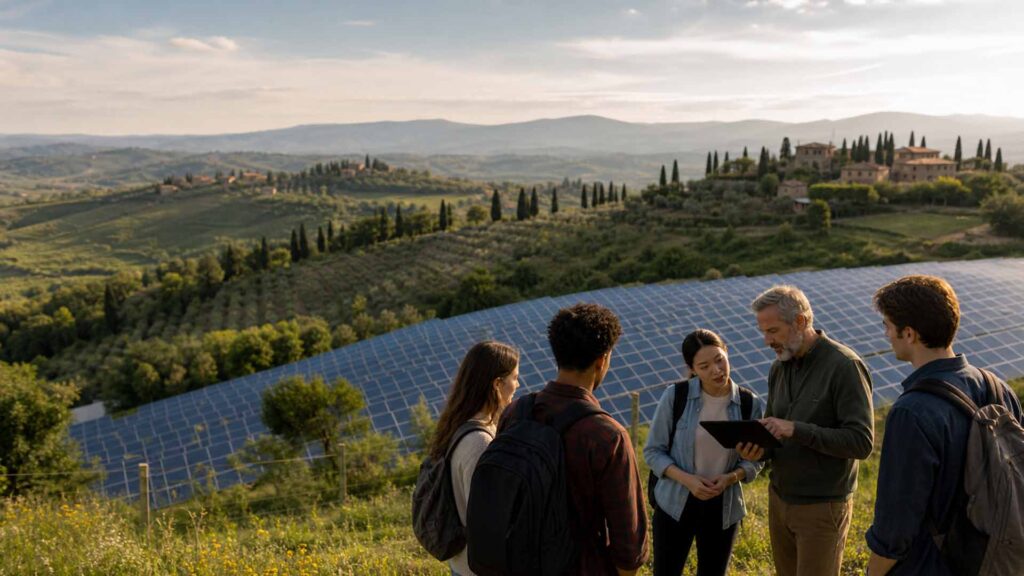
Italy has made strides in renewable energy development, particularly in solar and wind power. This course will examine Italy’s energy transition, focusing on the challenges and opportunities in adopting sustainable energy practices. Students will explore the technological, economic, and social aspects of Italy’s renewable energy projects.
Key Topics:
- The renewable energy landscape in Italy (solar, wind, hydro, and geothermal)
- Italy’s energy policy and climate goals
- Energy storage and smart grid technology
- Local energy cooperatives and decentralized energy systems
- The impact of renewable energy on local communities and industries
Fieldwork:
- Site visits to renewable energy plants.
Italy’s rich cultural heritage, from Roman ruins to Renaissance art, faces increasing threats from climate change, urbanization, and tourism. This course will explore how Italy is addressing the sustainability of cultural heritage and historic preservation, balancing environmental challenges with the need to protect its ancient sites.
Key Topics:
- Climate change impacts on Italy’s cultural heritage (e.g., Venice sinking, Pompeii preservation)
- Sustainable tourism and its effects on heritage sites
- The role of technology in preserving Italian cultural sites
- UNESCO World Heritage sites and sustainable management
- Community-driven preservation efforts in Italian villages
Fieldwork:
- Visits to heritage sites undergoing preservation work.
Language
Language learning is essential for cultural immersion and building a deeper connection to the local community. Students in non-English speaking location will complete language training to enhance their experience.