

Table of Contents
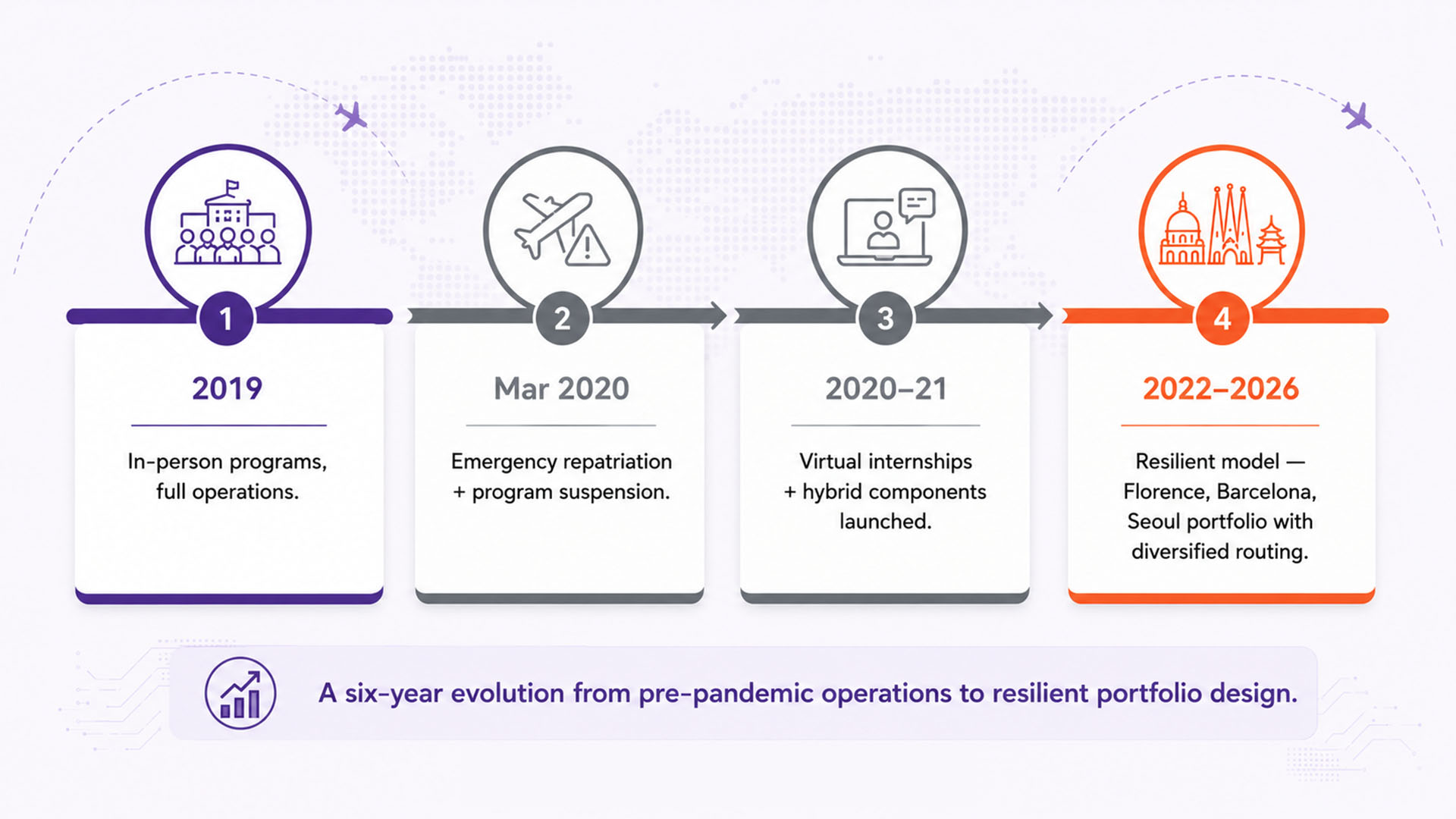
This is Part 5 of The Disruption Playbook, our six-part series for study abroad professionals navigating the planning challenges of 2027–28. In earlier parts our team has written about the new global routing environment, destinations where displaced programs can find new homes, a no-regrets approach to risk management, and the budget conversations rising airfares are forcing. This installment is more personal. I want to share what I learned about program design during the 2020 pandemic, and how those lessons are shaping the choices we are making at Authentica right now.
Six years on from the 2020 disruption, I find myself thinking about resilience differently than I used to.
In the second week of March 2020, I spent seventy-two hours doing something I never expected to do in this work: getting our students home. Flights were cancelled mid-itinerary. Borders closed faster than embassies could update guidance. I was on calls at three in the morning with university partners, country directors, host families, and parents. Everyone wanted answers I did not yet have. If you lived through that period, you remember what it felt like.
The shape of the current Middle East routing disruption is different — narrower, geographic rather than global, with no pandemic to suspend operations across the board — but the questions of resilient program design and disruption planning are uncomfortably familiar. The lessons I drew from 2020 are the ones I keep coming back to as we plan 2027–28, and I want to share what we learned about study abroad resilience that I think still applies.
Three things 2020 taught me
Other founders and directors will have drawn different lessons, and I respect that. These three are the ones I keep returning to.
| # | The lesson | What it looks like in practice |
|---|---|---|
| 1 |
Flexibility built in early costs much less than flexibility retrofitted later.
|
Multiple housing options, multiple academic pathways, the ability to shift between in-person and remote components — designed in from day one. |
| 2 |
Portfolio diversification is a survival mechanism, not a brand statement.
|
Programs spread across multiple regions, modalities, and partner types — so when one corridor closes, others remain available. |
| 3 |
Relationships are the most undervalued asset in this field.
|
Provider and university partnerships built before a crisis are the partnerships that hold during one. Managing them is a continuous activity. |
Figure 1: A summary of the three resilience lessons explored in this article. The detail follows below.
Source: Author analysis, drawing on Authentica’s program operations 2020–2026.
Below, each lesson in more depth.
1) Flexibility built in at the start costs much less than flexibility retrofitted later.
The programs that came back fastest in 2021 and 2022 were the ones that had even modest flexibility built into their original design — multiple housing options, multiple academic pathways, the ability to shift between in-person and remote components. Programs designed as rigid, single-format, single-destination experiences were the hardest to restart. The cost of building flexibility at the start is small. The cost of retrofitting it under pressure is enormous. Resilient program design begins at the design stage, not in the middle of a crisis. I do not want to be retrofitted again.
2) Portfolio diversification mattered more than I had appreciated.
Before 2020, I had thought of geographic diversification mostly as a brand statement — “we operate in many places”. The pandemic taught me it was a survival mechanism. The institutions that had concentrated their programs in a small number of destinations or providers found themselves with very few options when those specific corridors went dark. The institutions that had spread their work across regions, modalities, and partner types had levers to pull. I see that same pattern playing out now: the offices that built portfolio breadth into their post-2020 rebuild are the ones whose phones are ringing less urgently this season.
3) The single most undervalued asset in our field is the strength of a relationship.
Through the hardest months of 2020, the offices that fared best were the ones whose providers were already known to them as people, not just as line items on a contract. The same was true in reverse for us as a provider: the partners who stayed with us through the worst of it were the ones we had been transparent and present with long before there was a crisis. The Forum on Education Abroad said it well in their 2020 guidelines, and the line has stuck with me: managing partnerships well is not a contingency activity. It is a continuous one. That is now how I think about every university relationship we have.
Programs with built-in flexibility, diversified destinations, and strong provider relationships came through 2020 with their integrity intact. Those three traits are the ones I am building toward now.
What we did at Authentica, in plain terms
Our own experience in 2020 was, in honest terms, hard education. When borders started closing in March, we did what every provider did — we got our student’s home. Then we sat down and asked the harder question: what do we owe our partner universities now that travel is off the table?
The answer turned out to be virtual internships and hybrid components. We launched our first virtual internship cohort within weeks. It was not a perfect product. I will say that plainly because I think it is important to say. But it preserved the relationships with universities that mattered to us, and those relationships are what let us rebuild when borders reopened. I would not undo any of it.
Six years on, the takeaway is not that virtual internships are a permanent answer to disruption. They are not, and post-pandemic data has made that clear. The takeaway is that rapid adaptation under pressure is muscle. Either an organization has trained it, or it has not. The work we did in 2020 is, in retrospect, the reason we are planning 2027–28 calmly today.
How resilient program design has reshaped our portfolio
The clearest application of these lessons in our own work has been the way we have built our standard program portfolio over the past few years. Three programs, each playing a different role:
| Florence | Barcelona | Seoul (Coming Soon) | |
|---|---|---|---|
| Routing | Direct transatlantic | Direct transatlantic | Direct transpacific |
| Gulf dependency | None | None | None |
| Role in portfolio | Built post-2020 for resilience; European cultural and sustainability focus | Built post-2020 for resilience; smart-city, SDG 11 and 17 focus | Geographic diversification, Asia counterweight |
| Summer pricing | $5,670 / 6 credits | $5,980 / 6 credits | TBA |
| Fall semester | $17,900 / 12–15 credits | $17,610 / 12–15 credits | TBA |
Figure 2: The three Authentica standard programs, compared on the dimensions that matter most for resilience and operational continuity.
Source: Authentica internal data, May 2026. Pricing verified at authentica.com/locations.
Each program is worth a closer look. The longer story behind each one is below.
Italy — Florence: A program I designed after the pandemic, not before it
Florence was designed and launched after 2020, which gave us the rare luxury of building it with disruption-proofing as a starting principle rather than an afterthought. A few choices I made deliberately:
Direct transatlantic routes from every major US gateway. No Gulf dependency. No assumption that any single corridor would remain open.
Multiple housing arrangements — shared apartments and homestays within a 25-minute walk of our center — rather than a single dormitory whose closure would close the program.
An academic core, Sustainable Development in Context: Italy plus Innovation in Action: Project-Based Learning, that can use the city itself as the classroom. That reduces our dependency on any single institutional partner.
And, most importantly, our Program Director for Italy, Lorenzo Ciccarelli, who brings 25 years of in-country relationships that operate outside any of our formal contracts. Those relationships are the redundancy that do not show up on a balance sheet — and they matter more than any document we sign.
PROGRAM AT A GLANCE — STUDY ABROAD IN FLORENCE
- Summer: $5,670 | 6 credits
- Semester: $17,900 | 12–15 credits | (Required + Electives)
- Core curriculum: Sustainable Development in Context + Innovation in Action: Project-Based Learning
- SDG focus
- School of Record: Florida Agricultural & Mechanical University (FAMU)
- Housing: Shared apartments or homestays within 25 minutes walking distance of the Authentica Florence center
- Routing: Direct transatlantic from all major US gateways — zero Gulf dependency
- Applications: Rolling — 2027 terms now in planning
Study Abroad in Florence is open and enrolling for Fall 2026 and Spring 2027. Apply Now
Spain — Barcelona: A program refined through disruption
Barcelona was built alongside Florence, in the same wave, with the same lessons from 2020 informing both. What makes Barcelona distinct is the city it operates in. Barcelona has held leading positions on the UN Sustainable Development Goals 11 (Sustainable Cities and Communities) and 17 (Partnerships for the Goals) across multiple indices and has hosted the Smart City Expo World Congress every year since 2011. That civic infrastructure is part of what our students experience, and it is also part of why the program operates with such steady ground underneath it.
Operationally, the program shares Florence’s design principles: direct transatlantic routing, multiple housing arrangements rather than single-point-of-failure dormitories, an academic core that uses the city as classroom, and a strong local team that opens doors no formal contract could. Same playbook, different city, both designed from day one for resilience.
PROGRAM AT A GLANCE — STUDY ABROAD IN BARCELONA
- Summer: $5,980 | 6 credits
- Semester: $17,610 | 12–15 credits | (Required + Electives)
- Core curriculum: Sustainable Development in Context + Innovation in Action: Project-Based Learning
- SDG focus
- School of Record: Florida Agricultural & Mechanical University (FAMU)
- Housing: Shared apartments or student residences within 45 minutes walking or 20 minutes public transport of the school
- Routing: Direct transatlantic from all major US gateways — zero Gulf dependency
- Applications: Rolling — 2027 terms now in planning
Study Abroad in Barcelona is open and enrolling for Fall 2026 and Spring 2027. Apply Now
South Korea — Seoul: Portfolio diversification, on purpose
The third piece of our portfolio is the one I am most excited to introduce, even though I am holding the full details for our next installment. Adding a third standard program location in Asia is exactly the kind of diversification the 2020 lessons pointed to: a geographic counterweight to a European-heavy portfolio, an academic environment with genuine depth, and direct transpacific routing that does not depend on the Gulf corridor.
COMING SOON
A New Authentica Standard Program in Seoul
We are in the final stages of launching our third standard program location, in partnership with Sogang University in Seoul. A few reasons this destination matters to me, and to our portfolio:
- Direct transpacific routing from US West Coast hubs — no Gulf dependency.
- An academic environment that consistently performs at the top tier of the OECD’s PISA rankings.
- A geographic counterweight to a European-heavy portfolio — students who want Asia for the same learning objectives can find them here.
- A partnership I have built carefully, over time, with a host university that shares our standards for program design and student care.
I will share more in our next installment. To be notified directly, write to me at ravi@authentica.com.
What is different this time, and what is the same
I want to be careful not to suggest the current routing disruption is the same as the 2020 pandemic. It is not. Side by side, here is how the two compare on the dimensions that matter most to planning:
| Dimension | 2020 (Pandemic) | 2026 (Routing Disruption) |
|---|---|---|
| Scope | Global — every program in every country affected at once | Geographic — direct transatlantic and transpacific routing unaffected |
| Precedent available | None — no industry playbooks for pandemic-era program management | Yes — six years of post-pandemic institutional memory in every office |
| Operational options | Suspend, virtual, hybrid — and only after weeks of planning | Redirect to unaffected destinations, available immediately |
| Planning questions | How flexible is your program design? How diversified is your portfolio? How strong are your provider relationships? | Same three questions. The answers are now testable, six years on. |
Figure 3: 2020 pandemic vs 2026 routing disruption, on the dimensions most relevant to study abroad program planning.
Three differences are worth naming honestly:
Different: the disruption is geographic, not global.
In 2020, every program in every country was affected at once. In 2026, programs running on direct transatlantic and transpacific routing are operationally unaffected. The disruption is real, but it is narrower, and the toolkit for responding is correspondingly more targeted.
Different: we have playbooks now that we did not have then.
In March 2020, nobody knew what to do. There were no precedents, no industry guidelines for pandemic-era program management. Six years on, every study abroad office carries institutional memory from that period — what worked, what did not, who to call, how to communicate with families. We are not starting from scratch this time, and that matters.
The same: the planning questions are familiar.
How flexible is your program design? How diversified is your portfolio? How strong are your provider relationships? Those three questions did not stop being relevant when COVID receded. They are exactly the questions the current environment is asking again — and the institutions that built their answers into the post-2020 rebuild are the ones with the lightest load right now.
The thing I am most excited about: Our AI faculty proposal tool
One broader lesson I took from 2020 was that the tools our field uses to design programs — the proposal templates, the cost models, the destination matrices — were not built for the speed at which the world started moving. Faculty leading custom programs end up spending weeks pulling together a proposal that, frankly, should not take that long. The 2020 disruption made that gap obvious. The current routing disruption is making it obvious again.
So we built something. It is the project I am most excited about at Authentica right now, and the one I think will matter most for our partners over the next few years. We are calling it the Authentica AI Faculty Proposal Tool — a system that helps a faculty member turn their learning objectives, destination, dates, and group size into a structured, submission-ready program proposal in minutes, not weeks.
The tool is ready. To show you what it does — and what it means for the way faculty design programs from here on — we are hosting a live demo webinar.
Join our live demo of the Authentica AI Faculty Proposal Tool
We have built an AI-assisted system that helps faculty turn a learning objective, destination, dates, and group size into a structured, submission-ready program proposal in minutes.
- Watch the tool generate a real proposal in real time.
- See how faculty can use it to brief study abroad teams, deans, and risk committees.
- Stay for the Q&A and bring your hardest program-design questions.
None of this is a victory lap. The 2020 disruption was hard on everyone — students, faculty, staff at universities, staff at providers, host families, partner institutions. The lesson I drew from it is not that any one of us got everything right. It is that this field, working together, learned something it did not know before, and the institutions that absorbed those lessons are the ones with steady footing now.
Two weeks to NAFSA. The conversations about 2027–28 planning are getting concrete — and I would genuinely like to be in one with you.
14 DAYS TO NAFSA | MAY 26–29 | ORLANDO, FL
Let us find 30 minutes in Orlando.
I am holding 30-minute slots throughout NAFSA for working conversations with study abroad offices planning 2027–28. No deck, no pitch — just a candid conversation about the programs you are worried about, the destinations you are considering, and what other offices are doing that you might not have heard about. Two weeks out, my calendar is starting to fill.
- Bring the question your dean dropped on your desk last week.
- Bring the program you are not sure how to redirect.
- Or bring nothing — and we will talk about whatever you are thinking through.
→ Book a NAFSA meeting:
Cannot make Orlando? A video call works just as well. Write to me at ravi@authentica.com.
Warmly,
Ravi Raj
Founder & CEO, Authentica | ravi@authentica.com
The Disruption Playbook — Part 5 of 6
← Part 4 — The Budget Realities.
→ Next: Part 6 — The Opportunity in Disruption, plus the formal Seoul announcement.
Common questions I am hearing right now
Three questions come up in almost every conversation I am having with study abroad offices this season. Short answers below — happy to discuss in more depth at NAFSA or over a video call.
What did COVID actually teach study abroad providers about resilience?
The honest answer: flexibility built in at the design stage is much cheaper than flexibility retrofitted under pressure. Programs that survived 2020 had modest structural flexibility — multiple housing options, multiple academic pathways, strong provider relationships — already in place before the disruption hit. The institutions that learned this lesson and rebuilt with it in mind are the ones with the lightest load this season.
How do you design a study abroad program for disruption?
Three principles: direct routing wherever possible (no dependency on a single corridor), multiple housing arrangements rather than single-point-of-failure dormitories, and an academic core that uses the city as classroom rather than depending on one institutional partner. Add to that the relational layer — country directors with deep in-country networks that operate outside formal contracts — and you have a program that can absorb most of what the world throws at it.
What is the difference between the 2026 routing disruption and the 2020 pandemic?
The 2026 disruption is geographic, not global. Programs running on direct transatlantic and transpacific routing — like our Florence, Barcelona, and forthcoming Seoul programs — are operationally unaffected. The 2020 disruption suspended every program in every country at once. The current disruption is narrower, and the toolkit for responding is correspondingly more targeted. The planning questions, though, are familiar: how flexible is your program design, how diversified is your portfolio, how strong are your provider relationships?