● 08 July 2026 ●
When Off-the-Shelf Doesn’t Fit: Designing Custom Faculty-Led Study Abroad Programs Around Your Learning Goals
how to design a custom study abroad program
For Study Abroad Offices | 10 min read
Written By
Ravi Raj | Founder & CEO, Authentica
QUICK ANSWER
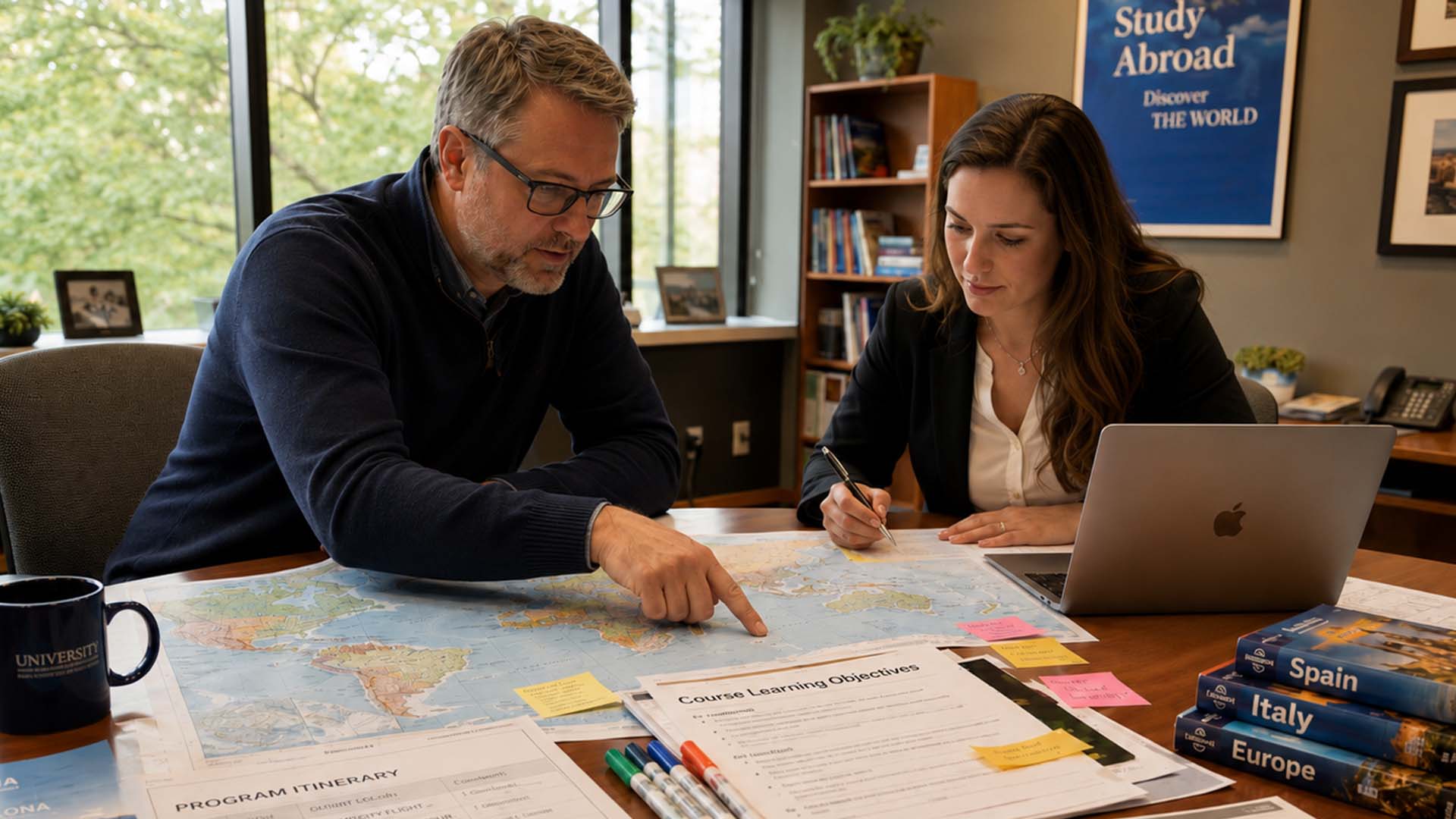
A custom faculty-led study abroad program is an academic experience built from the ground up around a specific set of learning objectives, rather than adapted from a pre-packaged itinerary. Instead of bending your course goals to fit someone else’s template, the program is co-designed with your faculty and study abroad office to match your curriculum, departmental goals, accreditation requirements, and the outcomes you want for students, giving your institution full control over both the academic and experiential content.
Some of the best programs I have seen in over a decade of this work did not start with a destination. They started with a sentence a professor could not stop thinking about — a learning outcome they could not fully deliver from a classroom in Ohio or Oregon.
Most providers sell a finished product: fixed dates, a fixed itinerary, and your course fits inside it. That works when the catalog matches your needs. But when a program carries specific outcomes clinical observation hours for nursing cohort, fieldwork for an environmental science course, AACSB alignment for a business school off-the-shelf starts to chafe. You end up adapting your goals to the program, when it should be the reverse.
The demand is not abstract. In 2023–24, 298,180 U.S. students studied abroad for credit — up 6% year over year, per the Institute of International Education’s Open Doors report — with Italy and Spain the top two destinations. Short-term programs of eight weeks or fewer have long been the majority; the Forum on Education Abroad put it at 65% of undergraduate programs back in 2017. Most faculty-led programs sit in that band — which is why directors keep asking me: should we build our own?
This is the framework I give them, the same one my team at Authentica uses when we sit down with a faculty lead and a blank page.
Table of Contents
What Is a Custom Faculty-Led Study Abroad Program?
A custom faculty-led study abroad program is one your institution designs, not selects. A faculty member leads it, your study abroad office co-owns it, and the academic content is yours — not a vendor’s. The provider’s job is to turn your objectives into a workable itinerary: partner institutions, logistics, housing, health and safety, and experiential pieces that a classroom cannot reproduce.
The distinction that matters is ownership. In tailored study abroad experiences, your learning objectives are brief. Faculty-led program development starts with what students should know, do, or value, then works backward to a destination and structure that deliver it. Everything else, dates, duration, even the country — is negotiable in service of that brief.
Off-the-Shelf vs. Custom Study Abroad: What Actually Differs
When directors weigh off-the-shelf vs. custom study abroad, the trade-off comes down to speed versus fit. Here is the honest comparison:
| Off-the-Shelf Programs | Custom Faculty-Led Programs |
|---|---|
| Pre-built itinerary and fixed content | Designed around your specific learning goals |
| The same program for every institution | Unique to your department and students |
| Limited flexibility on dates and destinations | Flexible dates, destinations, and duration |
| Generic academic content | Aligned with your curriculum and accreditation |
| You adapt your goals to fit the program | The program is built around your goals |
| Faster to set up | Needs planning lead time — but worth it |
| Less differentiation for students | Distinctive, memorable, and high impact |
What Are the Benefits of Custom Programs Over Standard Programs?
- Outcome alignment. The program is built around your objectives, not a vendor’s template, so what students do abroad maps directly to your syllabus.
- Accreditation fit. Credit hours, contact time, and assessment can be designed to satisfy accreditation and credit-transfer requirements from the start.
- Flexibility. Dates, destination, and duration flex to your academic calendar instead of the reverse.
- Departmental identity. A custom program becomes part of your department’s story — a distinctive experience students choose your program for.
- Reflection built in. Structured reflection — before, during, and after — is designed in, not bolted on. This is where short experiences become lasting learning.
- Faculty ownership. When faculty design the academic core, engagement is higher on both sides of the lectern.
How Do You Design a Study Abroad Program Around Learning Objectives?
This is the question that matters, and the answer is a process, not a leap. Here is the seven-step approach to custom study abroad program design we use with faculty leads:
- Define your core learning objectives. What should students know, do, or value by the end? Write these before you think about a single city.
- Identify the destination that delivers them. Choose the place whose cultural, academic, or experiential context best serves those objectives — not the other way around.
- Choose the program model. Decide whether it is best delivered as a Signature, Internship, Community-Based Learning, or Professional Development program. Each shapes the academic wrapper differently.
- Build the itinerary and logistics with a provider. Partner institutions, in-country logistics, housing, and on-the-ground support are where a provider like Authentica earns its place.
- Align with your calendar, credits, and accreditation. Map the program to your course calendar, credit hours, and any accreditation requirements before the design hardens.
- Design the academic wrapper. Pre-departure coursework, on-site assignments, and post-program reflection turn a trip into a course.
- Review and finalize the proposal. Close the loop with your study abroad office and faculty lead, then move to approval.
What Should Be Included in a Custom Program Proposal?
A strong custom international program design proposal gives your office and approval committee everything they need in one place. At minimum, include:
- A clear statement of learning objectives and intended outcomes
- The academic structure, credit hours, course alignment, and assessment plan
- A destination rationale that ties directly to the objectives
- A draft itinerary showing both academic and experiential components
- A health, safety, and risk management plan
- A transparent budget and per-student cost
- Faculty roles and the in-country support model
- Accreditation and credit-transfer notes
Drafting all that from scratch no longer must be daunting. Authentica’s AI-powered proposal tool turns your objectives, destination, dates, and group size into a structured first-draft proposal — itinerary, budget estimate, and more — in minutes, ready to refine with our team. You can request a proposal to try it.
Design a Program Proposal in Minutes
Authentica's AI proposal tool turns a faculty member's learning objectives, destination, dates, and group size into a structured, submission-ready draft proposal — in minutes. It generates:
Draft Itinerary
A draft itinerary matched to your learning objectives.
Budget Estimate
A clear budget estimate and per-student cost.
Risk & SDG Alignment
Risk considerations and an SDG-alignment map.
Human Review Layer
Every draft is reviewed by a person before it reaches your study abroad office.
Turn an idea into a proposal your committee can act on.
Try the AI Tool HereWhat Destinations Work Best for Custom Faculty-Led Programs?
The right destination is the one that delivers your objectives — and because a custom faculty-led program is not tied to a fixed catalog, that can be almost anywhere we operate across Asia and Europe. Portugal suits sustainability and startup themes; Japan and Singapore anchor technology, design, and business; Vietnam and Thailand deliver development and public-health fieldwork at accessible cost. What these destinations share is the foundation custom programs depend on — strong academic infrastructure, reliable safety, and direct routing from the U.S.
It is worth being clear about the difference here. Florence, Barcelona, and Seoul are our fixed standard programs — set academic architecture, set terms, ready to enroll. Custom faculty-led programs are the opposite model built from scratch for one institution, in the destination that best fits your objectives. If a standard program already delivers what you need, that is the faster path. Custom is how you reach everywhere else.
The Honest Part: Custom Programs Need Lead Time
I will not pretend customs are right for every program. It is not the fastest path, and not the cheapest line on day one. A well-built custom faculty-led program needs lead time, ideally nine to twelve months, to get the academic alignment, partner agreements, and risk planning right. When your need is urgent and your objectives are broad, a standard program is often the better call, and we will tell you so.
But when the objectives are specific, especially when they are the reason the program exists, the lead time is investment. The programs faculty are proudest of, the ones students name years later, are almost always built around a goal rather than bought off a shelf. That work starts with a conversation, not a contract.
Building a Program Around a Specific Learning Goal?
Tell us what you want students to walk away with, and we'll help you design a custom faculty-led program around it — destination, academics, logistics, and all. Our AI-powered proposal tool can even turn your learning objectives into a structured draft in minutes, ready for your study abroad office to review.
Ready to start?
Request a ProposalPlanning your first custom program?
Build a Draft with Our AI ToolFrequently Asked Questions
It is an internationally immersive course designed around your specific learning objectives and led by your own faculty, rather than adapted from a pre-built itinerary. Your institution owns the academic content; a provider builds the destination, logistics, and experiential components around it.
Plan for nine to twelve months from first conversation to departure. Shorter timelines work for simpler designs, and our AI proposal tool can generate a first draft in minutes to speed the early stage — but academic alignment, partner agreements, and risk planning still benefit from lead time.
Yes. Authentica’s AI proposal tool lets faculty enter their learning objectives, destination, dates, and group size, then generates a structured draft — itinerary, budget estimate, risk considerations, and SDG alignment — in minutes. A human review layer refines it before it reaches your office. You can Request a Proposal to try it.
In a faculty-led program, your professor designs and teaches the academic core and travels with the cohort. In a partner or off-the-shelf program, students join an existing program run by a provider or host institution. Faculty-led offers more control and alignment; partner programs are faster to access.
Yes, department-level programs are often the strongest fit, because the objectives are clear and the faculty champion is engaged. A program built for a single nursing, business, or environmental science cohort can be tailored far more precisely than a general-audience offering.
Build the academic structure, credit hours, contact time, assessment, and learning outcomes — to your accreditation standards from the start, and document how each element maps to those requirements. Aligning early is far easier than retrofitting later.
Your faculty does. The academic content, assignments, and assessment belong to the institution. The provider designs the in-country experience, partner relationships, and logistics that bring the curriculum to life.
The best destination is the one that delivers your objectives. Because custom programs are not tied to a fixed catalog, they can run across our operating regions in Asia and Europe — Portugal, Japan, Singapore, Vietnam, and beyond — wherever academic infrastructure, safety, and direct routing are strong. (Florence, Barcelona, and Seoul are available separately as fixed standard programs.)
They can carry higher design costs up front, but cost depends on destination, duration, and group size — and the alignment with your objectives often delivers more value per dollar. A transparent, per-student budget should be part of every proposal.
About the author
Ravi Raj is the co-founder and CEO of Authentica, an experiential learning provider that has designed and delivered international academic programs since 2012. Over that time, he has worked with more than 40 university partners across 35-plus countries, building both standard semester programs and custom faculty-led experiences for study abroad offices. He writes about the practical realities of program design for international educators.