

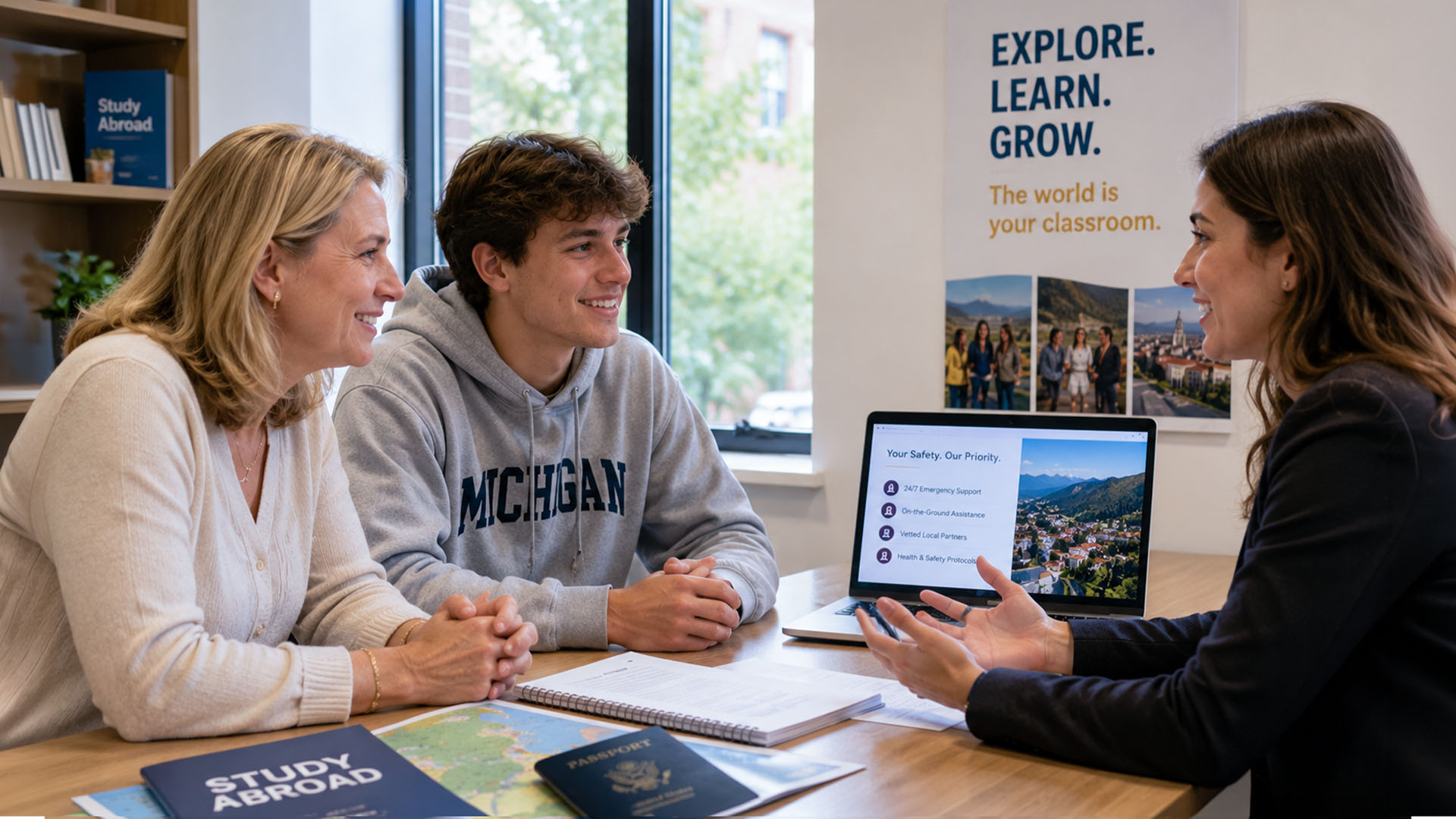
This is Part 3 of Reading the Signals, our five-part series for study abroad offices planning 2026–27 and beyond. Part 1 read the demand data; Part 2 took on cost. This part covers the concern that carries the most emotional weight in every family conversation: safety.
For a generation of students, the safety question is no longer the fine print. It is the first fork in the decision.
The research we unpacked in Part 1 of this series made the pattern plain: students are still going, but nearly all of them now weigh world events in the decision, and they are interviewing your office and your providers along with the destination. Study abroad safety, in other words, has stopped being a compliance topic and become a participation topic. The offices that answer it with specifics are converting anxious families into enrolled students; the offices that answer with reassurance are losing them to silence.
This post is written for the people who own that answer: program directors, senior international officers, and the advisors who receive the email when a headline breaks. We will look at the shift from risk management to risk communication, the four questions students and parents are already asking, and what a credible, quotable safety posture looks like in practice.
How Does Safety Shape Study Abroad Participation in 2026–27? The Quick Answer
Safety concern is now near universal but not paralyzing: most students still plan to go abroad, but world events shape where, when, and with whom they go. The deciding factor has shifted from whether a destination feels safe to whether the institution and provider can show — specifically and quickly — how safety is monitored, resourced, and communicated. Offices that answer well convert concern into confidence; offices that stay generic lose the student to silence.
From Risk Management to Risk Communication
Most study abroad offices already do serious risk work: insurance review, provider vetting, emergency protocols, advisory monitoring. What has changed is not that this work matters more, it is that the work now has an audience. Risk management used to be a back-office function whose success was invisible. Risk communication is a front-office function whose absence is what students and parents notice.
The practical difference shows up in three places. First, in recruitment: safety questions now arrive at the info-session stage, and “we take safety very seriously” is the answer that ends conversations. Specifics start them — who monitors, what triggers action, what happened the last time something happened. Second, in family dynamics: parents increasingly co-decide, and a parent who gets a fast, concrete answer to a headline becomes an advocate rather than a veto. Third, in provider selection: the offices we work with have started scoring providers on the quality of their incident communication, not just the existence of a protocol binder.
One caveat belongs in every safety conversation and stating it builds credibility rather than spending it: perceived risk and actuarial risk are not the same thing. A destination can be statistically safe and still lose enrollments to a headline, just as familiarity can make a riskier place feel benign. The office’s job is not to lecture families out of their perceptions — it is to meet those perceptions with specific, honest, current information and let credibility do the persuading.
Four Questions Students and Parents Are Already Asking
These arrive by email, at info sessions, and in application-season phone calls. The offices that pre-write the answers — with their providers named in them — respond in hours instead of committee cycles.
Name the monitoring sources your office and providers actually use — government advisories, security intelligence, on-ground staff — and how often they are checked. “We monitor the situation” is a sentence; a named stack is an answer.
Families have seen programs change plans mid-term in recent years, and they remember. Describe your escalation ladder in plain language: what conditions trigger a change of plan, who decides, what the housing and academic-continuity arrangements are, and how families hear about it. If your provider cannot articulate their half of that ladder, that is itself a finding.
This is the insurance question, asked by people who have never read a policy. The answer should name coverage types and limits, what the provider carries versus what the student carries, and where the gaps are that travel insurance should fill. Vagueness here reads as exposure.
Channel, speed, and voice. Families want to know that in a genuine incident they will hear from a named human, through a stated channel, within a stated window — not discover the news themselves and wait. A one-page communication commitment, published, is worth more reassurance per word than any brochure paragraph.
What a Credible Safety Posture Looks Like
Since this series shares our own work where relevant: Authentica’s safety architecture is published in full on our health, safety, and risk management page, and it is built to be quoted in exactly the conversations above. Programs run with 24/7 on-ground staff assistance, first-aid-trained teams, and real-time destination monitoring; the company carries $5M in commercial general liability coverage and $1M in errors and omissions coverage; families have a dedicated Family and Parent Resource Center; and all three of our standard programs — Florence, Barcelona, and Seoul — were deliberately built on direct transatlantic and transpacific routings with international insurance included in the program fee. None of that makes risk disappear, nothing does, and a provider who implies otherwise should worry you. What it does is give your office specific, verifiable sentences to say when the four questions arrive. That is what “table stakes” means now: not a safer world, but a fully answerable one. More on how we work is at Why Authentica.
The Authentica AI Proposal Tool
Safety design belongs at the start of a program’s life, not its end. A faculty member enters learning objectives, destination, dates, and group size, and the tool returns a structured program draft — itinerary, budget estimate, risk assessment, and SDG alignment, in minutes, with our program designers reviewing every draft before it goes anywhere.
- Itinerary
- Budget estimate
- Risk assessment
- SDG alignment
Every draft includes a risk assessment template from its very first version, so the contingency conversation begins at the proposal stage, before a deposit is taken or a flight is priced.
Early access is open →Frequently Asked Questions
For most students, yes — hundreds of thousands of US students study abroad each year, and most programs run without serious incident. The better question is program-specific: how is this program monitored, what is the escalation plan, what insurance stands behind it, and how families will be told if something happens. Programs that answer all four in writing are the ones to trust.
Many of the most popular destinations — across Western Europe and East Asia — sit consistently high on global safety indices. But country rankings matter less than program infrastructure: on-ground staffing, real-time monitoring, insurance coverage, and communication protocols protect students in any destination. Compare those four before comparing countries.
Four: who monitors conditions and with what named sources; what happens if a destination changes mid-program; what insurance — with types and limits — stands behind the program; and how, and how fast, families are told when something happens.
Named coverage with stated limits, published where families can find it. Authentica, for example, carries $5M in commercial general liability coverage and $1M in errors and omissions coverage, with international insurance for students included in every program fee.
The institutions and providers’ obligation to anticipate, monitor, and respond to risks to students — and, increasingly, to demonstrate that work visibly before families ask for it. In practice it spans pre-departure preparation, on-ground support, incident response, and family communication.
Ask for the program’s communication commitment in writing before departure: the channel, the response window, and who contacts families in a genuine incident. Authentica pairs 24/7 staff assistance with a dedicated Family and Parent Resource Center so parents know where to look and who answers.
Our five-part series for study abroad offices planning 2026–27 and beyond.
Part 4 unfolds the new destination map, where student interest is heading for 2026–27, why Spain and Italy are pulling ahead, and why our newest standard program opened in Seoul.
Pressure-test your safety answers before students ask
Bring us the four questions above and your current answers. We will share the communication templates, escalation frameworks, and provider-evaluation questions we use — whether or not an Authentica program is the outcome.
Request a working session →For a generation of students, the safety question is no longer the fine print. It is the first fork in the decision.
The research we unpacked in Part 1 of this series made the pattern plain: students are still going, but nearly all of them now weigh world events in the decision, and they are interviewing your office and your providers along with the destination. Study abroad safety, in other words, has stopped being a compliance topic and become a participation topic. The offices that answer it with specifics are converting anxious families into enrolled students; the offices that answer with reassurance are losing them to silence.
This post is written for the people who own that answer: program directors, senior international officers, and the advisors who receive the email when a headline breaks. We will look at the shift from risk management to risk communication, the four questions students and parents are already asking, and what a credible, quotable safety posture looks like in practice.
How Does Safety Shape Study Abroad Participation in 2026–27? The Quick Answer
Safety concern is now near universal but not paralyzing: most students still plan to go abroad, but world events shape where, when, and with whom they go. The deciding factor has shifted from whether a destination feels safe to whether the institution and provider can show — specifically and quickly — how safety is monitored, resourced, and communicated. Offices that answer well convert concern into confidence; offices that stay generic lose the student to silence.
From Risk Management to Risk Communication
Most study abroad offices already do serious risk work: insurance review, provider vetting, emergency protocols, advisory monitoring. What has changed is not that this work matters more, it is that the work now has an audience. Risk management used to be a back-office function whose success was invisible. Risk communication is a front-office function whose absence is what students and parents notice.
The practical difference shows up in three places. First, in recruitment: safety questions now arrive at the info-session stage, and “we take safety very seriously” is the answer that ends conversations. Specifics start them — who monitors, what triggers action, what happened the last time something happened. Second, in family dynamics: parents increasingly co-decide, and a parent who gets a fast, concrete answer to a headline becomes an advocate rather than a veto. Third, in provider selection: the offices we work with have started scoring providers on the quality of their incident communication, not just the existence of a protocol binder.
One caveat belongs in every safety conversation and stating it builds credibility rather than spending it: perceived risk and actuarial risk are not the same thing. A destination can be statistically safe and still lose enrollments to a headline, just as familiarity can make a riskier place feel benign. The office’s job is not to lecture families out of their perceptions — it is to meet those perceptions with specific, honest, current information and let credibility do the persuading.
Four Questions Students and Parents Are Already Asking
These arrive by email, at info sessions, and in application-season phone calls. The offices that pre-write the answers — with their providers named in them — respond in hours instead of committee cycles.
Name the monitoring sources your office and providers actually use — government advisories, security intelligence, on-ground staff — and how often they are checked. “We monitor the situation” is a sentence; a named stack is an answer.
Families have seen programs change plans mid-term in recent years, and they remember. Describe your escalation ladder in plain language: what conditions trigger a change of plan, who decides, what the housing and academic-continuity arrangements are, and how families hear about it. If your provider cannot articulate their half of that ladder, that is itself a finding.
This is the insurance question, asked by people who have never read a policy. The answer should name coverage types and limits, what the provider carries versus what the student carries, and where the gaps are that travel insurance should fill. Vagueness here reads as exposure.
Channel, speed, and voice. Families want to know that in a genuine incident they will hear from a named human, through a stated channel, within a stated window — not discover the news themselves and wait. A one-page communication commitment, published, is worth more reassurance per word than any brochure paragraph.
What a Credible Safety Posture Looks Like
Since this series shares our own work where relevant: Authentica’s safety architecture is published in full on our health, safety, and risk management page, and it is built to be quoted in exactly the conversations above. Programs run with 24/7 on-ground staff assistance, first-aid-trained teams, and real-time destination monitoring; the company carries $5M in commercial general liability coverage and $1M in errors and omissions coverage; families have a dedicated Family and Parent Resource Center; and all three of our standard programs — Florence, Barcelona, and Seoul — were deliberately built on direct transatlantic and transpacific routings with international insurance included in the program fee. None of that makes risk disappear, nothing does, and a provider who implies otherwise should worry you. What it does is give your office specific, verifiable sentences to say when the four questions arrive. That is what “table stakes” means now: not a safer world, but a fully answerable one. More on how we work is at Why Authentica.
The Authentica AI Proposal Tool
Safety design belongs at the start of a program’s life, not its end. A faculty member enters learning objectives, destination, dates, and group size, and the tool returns a structured program draft — itinerary, budget estimate, risk assessment, and SDG alignment, in minutes, with our program designers reviewing every draft before it goes anywhere.
- Itinerary
- Budget estimate
- Risk assessment
- SDG alignment
Every draft includes a risk assessment template from its very first version, so the contingency conversation begins at the proposal stage, before a deposit is taken or a flight is priced.
Early access is open →Frequently Asked Questions
For most students, yes — hundreds of thousands of US students study abroad each year, and most programs run without serious incident. The better question is program-specific: how is this program monitored, what is the escalation plan, what insurance stands behind it, and how families will be told if something happens. Programs that answer all four in writing are the ones to trust.
Many of the most popular destinations — across Western Europe and East Asia — sit consistently high on global safety indices. But country rankings matter less than program infrastructure: on-ground staffing, real-time monitoring, insurance coverage, and communication protocols protect students in any destination. Compare those four before comparing countries.
Four: who monitors conditions and with what named sources; what happens if a destination changes mid-program; what insurance — with types and limits — stands behind the program; and how, and how fast, families are told when something happens.
Named coverage with stated limits, published where families can find it. Authentica, for example, carries $5M in commercial general liability coverage and $1M in errors and omissions coverage, with international insurance for students included in every program fee.
The institutions and providers’ obligation to anticipate, monitor, and respond to risks to students — and, increasingly, to demonstrate that work visibly before families ask for it. In practice it spans pre-departure preparation, on-ground support, incident response, and family communication.
Ask for the program’s communication commitment in writing before departure: the channel, the response window, and who contacts families in a genuine incident. Authentica pairs 24/7 staff assistance with a dedicated Family and Parent Resource Center so parents know where to look and who answers.
Our five-part series for study abroad offices planning 2026–27 and beyond.
Part 4 unfolds the new destination map, where student interest is heading for 2026–27, why Spain and Italy are pulling ahead, and why our newest standard program opened in Seoul.
Pressure-test your safety answers before students ask
Bring us the four questions above and your current answers. We will share the communication templates, escalation frameworks, and provider-evaluation questions we use — whether or not an Authentica program is the outcome.
Request a working session →