

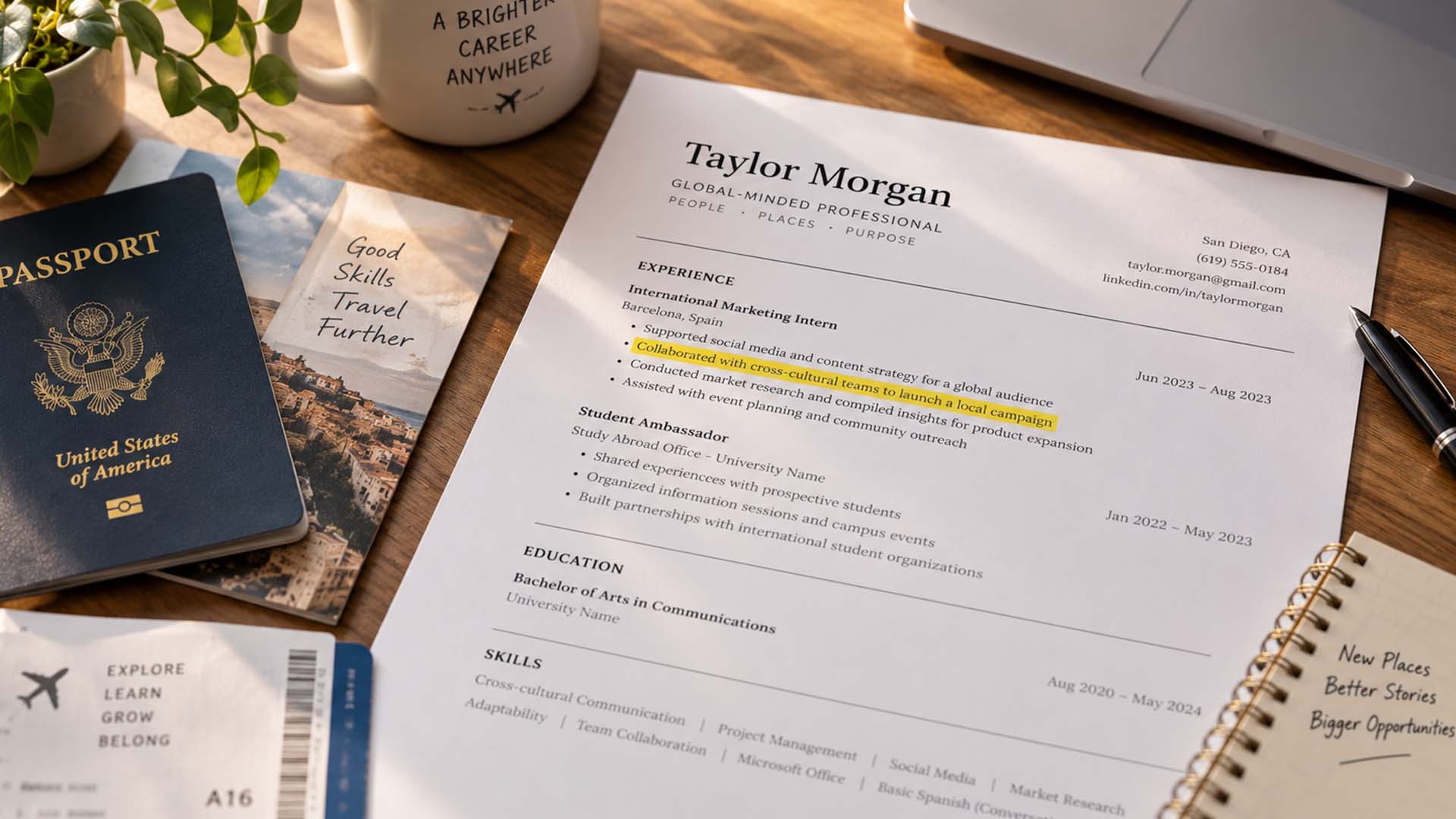
This is Part 4 of The Internship Edge; the handout. When an intern comes home, this is the piece your office or career center gives them, because the placement was only half the work. The other half is the telling.
Here is a quiet scandal from the alumni research: most graduates were never asked about their international experience in a first job interview.
Not because the experience lacks value - the salary and skills evidence in Part 1 says the opposite, but because most candidates file it where employers cannot use it: a location line, a semester, a story about food. The experience is not underpowered. It is under-translated. And translation is a learnable skill with rules, examples, and a formula, which is exactly what this guide is: the internship abroad resume bullets that work, the 60-second interview answer, and the vocabulary employers actually respond to. Advisors: this is written to be handed to every returning intern, while the work is still fresh enough to name.
The Interview Gap: Why Great Experiences Go Unasked-About
Under Experience, not Education. Lead with the project and the outcome rather than the city: one to two bullets naming what you built, for whom, and what happened to it, plus a clause marking the cross-cultural context, “delivered in a Korean workplace” does more than “Seoul, South Korea” ever will.
The alumni evidence is consistent on this point: 94% of education abroad alumni say the experience built their job skills, yet the Forum on Education Abroad’s newest career-focused research, the Career Catalyst Alumni Survey, drawing on 7,984 responses from education-abroad alumni, one of the largest studies of its kind, is examining exactly this gap: how global learning contributes to career development, professional agility, and workforce skills, and why the story so often goes untold at the one moment it would matter most. The full skills and salary data lives in Part 1; the practical conclusion lives here: employers do not skip international experience because they do not care. They skip it because “Marketing Intern, Bangkok” gives them nothing to ask about. Your job is to write the line they cannot skip.
How to Put an Internship Abroad on Your Resume (Before-and-After Examples)
Three rules before the examples, and NACE’s own employer research backs all three: in its Job Outlook 2025 survey of hiring managers, nearly 90% said they look for evidence of problem-solving on a student resume, and nearly 80% look for teamwork - not the words themselves, but proof.
Experience, Not Education
It goes under Experience, not Education; a placement with a real project, a supervisor, and a deliverable is work, and filing it under coursework demotes it.
Work, Not Geography
Lead with the work, not the geography; the city is context, the project is content.
Deliverable and Outcome
Every bullet names a deliverable and an outcome; what you built, for whom, and what happened to it.
A resume that says “adaptable” proves nothing; a resume that shows the problem you solved and the team you solved it with is speaking the language employers are already listening for. Now watch the rules operate:
Global Innovation Intern, Seoul, South Korea (Summer 2027)
Analyzed subscription-churn drivers for a Seoul consumer-tech firm and delivered a retention playbook adopted by the growth team — scoped, presented, and defended in a cross-cultural workplace over eight weeks.
Engineering Intern in Singapore — assisted the sustainability team
Built a water-usage model for a Singapore engineering host’s retrofit project, cutting estimated consumption 12% in the proposal phase — the model shipped with the client bid.
Healthcare internship in Thailand; observed hospital operations
Mapped patient-intake bottlenecks across two Thai clinic sites and proposed a triage redesign presented to clinic leadership — first professional deliverable produced outside my home country and language.
Three real placement types, rewritten by the same three rules.
The numbers and outcomes above are illustrative, every strong bullet uses the student’s real project, real deliverable, and real result. If a bullet cannot name all three, the fix is not better writing; it is remembering the work while it is fresh. That is why structured placements end with an artifact.
The Words Employers Can Hear
“It changed my life” is true and unhirable. The translation move is to swap feelings for competencies, and two different datasets agree on which ones matter: what alumni say the experience actually built in them, set beside what employers say they are already screening resumes for.
What alumni say they built
What employers look for
Also: written comm., initiative, work ethic, tech skills (70%+) · verbal comm., adaptability, analytical skills (two-thirds+)
Left: The Forum on Education Abroad, EA Alumni Survey (2025) · Right: NACE, Job Outlook 2025 (n = 237 employers) — two datasets, the same answer: alumni-reported growth next to employer-reported demand.
Look at the two charts side by side and the strategy writes itself: the skills alumni report building are, almost line for line, the skills NACE’s Job Outlook survey says employers are already looking for. These map directly onto NACE’s eight official career-readiness competencies, career and self-development, communication, critical thinking, equity and inclusion, leadership, professionalism, teamwork, and technology; the framework career centers and employers both use. The goal is never to copy those words onto a resume unproven; it is to use the formula: competency + situation + evidence. Not “I’m adaptable,” but “Adaptability: my project brief changed in week two when the host reprioritized, and I re-scoped the deliverable and still shipped on time.” One sentence, one skill, one proof. A resume, an interview, and a LinkedIn profile are just three containers for that same sentence.
The 60-Second Interview Answer and the LinkedIn Line
The interview answer has four beats: the situation (a real project for a real organization abroad), the work (what you personally owned), the outcome (the deliverable and what happened to it), and the skill (the competency it proves; chosen to match the role you are sitting in front of). Sixty seconds, no travelogue, end on the skill. The framework:
Four beats. No travelogue. End on the skill.
Situation
A real project for a real organization abroad
Work
What you personally owned
Outcome
The deliverable — and what happened to it
Skill
The competency it proves, matched to the role
The same four beats work whether the interviewer asks first — or you plant the line yourself.
Four beats, four disciplines, four placements; here is what the framework sounds like once it is filled in:
Business - Bangkok, Thailand
“A Bangkok manufacturer needed its export paperwork standardized for English-speaking clients. I rebuilt their quote templates end to end. Client turnaround questions dropped by half, and the company adopted the format across the business. That’s process design under real commercial constraints.”
Art - Florence, Italy
“A Florence social enterprise needed a visual identity for a new sustainability initiative. I designed the brand system and an exhibit panel for its public launch. It’s still their default template. That’s creative work that had to survive contact with a real audience and a real deadline.”
Media & Journalism - Seoul, South Korea
“A Seoul media startup needed English-language explainers for an international audience. I researched, wrote, and edited three pieces for their platform. One became the company’s top-performing English post that month. That’s cross-cultural storytelling on an editorial deadline.”
Engineering - Bangalore, India
“A Bangalore engineering firm needed a water-efficiency audit for a retrofit project. I built the usage model and tested two design scenarios. My recommended scenario was the one that went into the client proposal. That’s technical modeling that had to hold up against a real budget.”
These four are illustrative templates, not verbatim placements — the shape to fill in with a student’s actual project, city, and host. Bangkok, Florence, Seoul, and Bangalore across business, art, media, and engineering are also a preview of where the placement board is headed next — the same “new placements joining the board” promise on the program page, made concrete.
When the interviewer never asks and most do not, plant it yourself: “The most useful thing I have shipped was actually built in Singapore…” is a sentence no interviewer has ever declined to follow, the Bangkok manufacturer, the Florence brand system, whichever line is yours.
On LinkedIn, the placement is an Experience entry with the host organization named, not a line in your About section, because recruiters search experience fields, not prose. Attach the artifact if it is shareable and ask your mentor or project supervisor for a recommendation while the work is fresh. Specificity is not just good writing here; it is measurable. A resume-audit field experiment that tested fictional resumes found that listing study abroad experience in Asia raised interview callback rates by about 20%, regardless of length; but the same study found that a full year in Europe, listed generically, was associated with fewer callbacks than listing no international experience at all. The honest reading is not “list Asia, skip Europe”; it is that vague international experience can cost you exactly where specific, well-told experience pays off. The line only works when it says what you did.
Business Development Intern — [Host Company], Bangkok, Thailand
“Rebuilt client-facing quote templates for export documentation, cutting client turnaround questions by half. Adopted company wide.”
- The Forum on Education Abroad, EA Alumni Survey and Career Catalyst research (2025). Drawing on 7,984 responses from education-abroad alumni — one of the largest studies of its kind.
- National Association of Colleges and Employers (NACE), Job Outlook 2025. Survey of hiring managers on the skills and competencies they screen student resumes for (n = 237 employers).
- Cheng, A. and Florick, L., “The Value of Study Abroad Experience in the Labor Market: Findings from a Resume Audit Experiment” (EDRE Working Paper, 2020). A resume-audit field experiment testing fictional resumes with study abroad experience listed.
Caveat: the four interview examples above (Bangkok/business, Florence/art, Seoul/media, Bangalore/engineering) are illustrative — an intentional tease for destinations and disciplines joining the placement board, not claims about currently published programs.
→ The line on the resume starts with a placement: engineering, innovation, start-ups, climate, and healthcare at authentica.com/programs/internships-abroad.
For the offices handing this out: this guide is the cheapest career outcome you will fund all year - a translation session with returning interns, run by advising or career services with this framework, is the handoff step from Part 3’s design framework that converts placements into the outcome stories your next proposal cites. And if your students do not yet have placements to translate, that is the earlier conversation; it starts at request a proposal.
Frequently Asked Questions
Under Experience, not Education. Lead with the project and the outcome rather than the city: one to two bullets naming what you built, for whom, and what happened to it, plus a clause marking the cross-cultural context, “delivered in a Korean workplace” does more than “Seoul, South Korea” ever will.
Four beats in sixty seconds: the situation (real project, real organization abroad), the work you personally owned, the outcome (the deliverable and its fate), and the skill it proves, chosen to match the role. Since interviewers do not always ask about international experience on their own, plant it yourself rather than waiting.
Yes — as an Experience entry with the host organization named, not just a line in your About section, because recruiters search experience fields. Attach the work product where shareable, and request a mentor or supervisor recommendation while the placement is fresh.
The ones alumni report building - adaptability, communication and interpersonal skills, intercultural communication, and creative problem-solving, and they line up closely with what NACE’s employer research says companies are already screening resumes for, led by problem-solving and teamwork. The rule for using them: name the skill with evidence, never as an adjective.
The evidence says specificity matters more than the fact of it. A resume-audit field experiment found that listing study abroad in Asia raised interview callback rates by roughly 20%, while a full year in Europe listed generically was linked to fewer callbacks than listing nothing at all - a reminder that vague claims can cost you exactly where a specific, well-told experience pays off. Make it checkable: name the host organization, keep the deliverable, and offer the project supervisor as a reference.
Six parts, one gap closed: signal, guide, program, resume, offer, retention.
Next Week, Part 5: Where the Work Is; the cities where an internship abroad means something, and how to match a major to a map.
The placement was half the work. Finish the sentence.
Students: one project, one deliverable, one competent entry, write the bullet today while the work is fresh. Advisors: hand this to every returning intern and let the next cohort start with a placement worth translating.