

Introduction to Korean History
Seoul, South Korea · Five Thousand Years of History
Course Description
Korean history is one of the great long arcs of world history — five thousand years of cultural continuity on a single peninsula, punctuated by spectacular dynastic flourishings, repeated invasions from larger neighbors, a brutal twentieth-century colonization, division and war, and one of the most rapid social transformations any society has experienced. To understand contemporary Korea — its politics, its economy, its culture, its global posture — students need its history.
This course offers an introduction to Korean history from the Three Kingdoms period through the contemporary Republic of Korea, with Seoul itself serving as a living classroom. Students will visit royal palaces, museums, war memorials, and the DMZ; engage directly with Korean historians; and develop the historical literacy needed to read Korean politics, Korean culture, and Korean self-understanding with depth and care. The course does not assume prior knowledge of Korea, Asia, or East Asian history.
Aligned with the UN Sustainable Development Goals
While historical study is not directly tied to SDG implementation, this course addresses themes central to SDG 16 (Peace, Justice and Strong Institutions), SDG 11 (Sustainable Cities and Communities, through heritage preservation), and SDG 4 (Quality Education) — using history to understand how contemporary institutions, peace, and identity are built and contested.
Key Topics
Learning Objectives
By the end of this course, students will be able to:
-
Identify the major periods, dynasties, and turning points of Korean history, and place them in regional East Asian context.
Assessment: Assessment: Midterm timeline-and-essay exam.
-
Analyze the social, political, and cultural institutions of the Joseon dynasty, and explain their continuing influence on contemporary Korean society.
Assessment: Assessment: Short essay (1,500 words) on Joseon institutions and contemporary resonance.
-
Evaluate the legacies of Japanese colonization on twentieth-century Korea, both North and South, including economic, political, and cultural dimensions.
Assessment: Assessment: Research-based response to a primary-source set on the colonial period.
-
Engage critically with historical memory and contested narratives — examining how Koreans, Japanese, Chinese, and Western historians have framed the Korean past.
Assessment: Assessment: Comparative historiography essay.
-
Connect historical analysis to contemporary Korean issues — North-South relations, US-ROK alliance, gender, memory politics — through a final research project.
Assessment: Assessment: Final research paper and presentation.
Course Format and Assessment Methods
Total grade is composed of the following weighted components:
Course Outline
The course is organized into the following sessions, which may be combined or expanded depending on summer vs. semester format.
-
Why Korean History MattersCourse framing: why study Korean history, what makes Korean historiography distinctive, and how to use Seoul as a classroom.
-
The Three Kingdoms and Unified SillaGoguryeo, Baekje, Silla — the early peninsular states and their cultural and political consolidation under Unified Silla.
-
Goryeo: Buddhism, Print, and StatecraftThe Goryeo dynasty, the introduction of Buddhist culture and the world's first metal movable type.
-
Joseon FoundationsThe founding of Joseon, Neo-Confucian state ideology, King Sejong, and the creation of hangeul.
-
Joseon SocietySocial structure (yangban, sangmin, cheonmin), the civil service examination, and gender in the long Joseon order.
-
Late Joseon and Encounters with the WestForeign pressure in the nineteenth century, the Donghak movement, and the late Joseon political crisis.
-
Japanese ColonizationThe protectorate, annexation, the colonial economy, mass mobilization, and the comfort women issue.
-
Liberation and Division1945, US and Soviet occupation, the creation of two Koreas, and the precursors to war.
-
The Korean WarCauses, the war itself, civilian devastation, armistice, and the war's lasting imprint on both Koreas.
-
Authoritarian DevelopmentPark Chung-hee, the economic miracle, political repression, and the costs of authoritarian modernization.
-
DemocratizationThe 1987 democratic transition, civil society, and the construction of the post-1987 republic.
-
North Korea: A Parallel HistoryThe DPRK from 1948 — Kim Il-sung, juche, famine, the nuclear program, and what we know and don't know.
-
Contemporary KoreaThe post-1997 social transformation, the chaebol question, gender politics, and Korea's global rise.
-
Memory, Politics, and the Korean PresentHow Koreans remember — and contest — their own history. Capstone presentations.
Field Visits and Guest Speakers
Seoul is the city as classroom. Course-related field components vary by term and availability, but examples include:
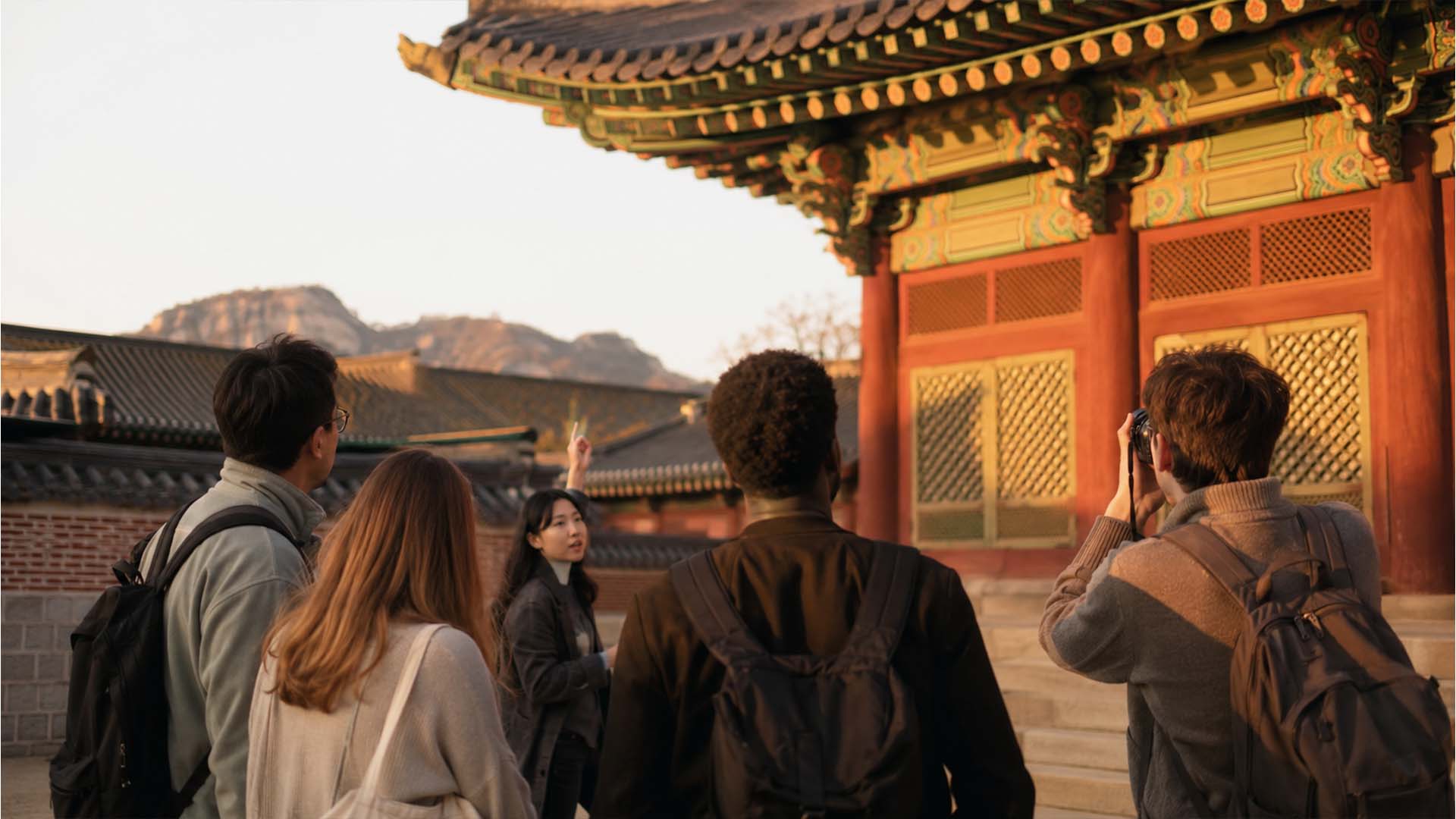
- Guided visits to Gyeongbokgung and Changdeokgung palaces with a Korean historian.
- Day-long tour to the DMZ and Joint Security Area, with historical and contemporary framing.
- Visit to the National Museum of Korea and the War Memorial of Korea.
- Walking tour of Bukchon Hanok Village and the historic urban fabric of Seoul.
- Visit to the Independence Hall of Korea (Cheonan) — Korea's national museum of resistance and liberation history.
- Seminar at the Northeast Asian History Foundation or Academy of Korean Studies.
Readings & Resources
Selected readings and resources for this course. Full syllabus and reading list provided at enrollment.
Books
Cumings, Bruce. Korea's Place in the Sun: A Modern History. Updated ed. New York: W.W. Norton, 2005.
Eckert, Carter J., et al. Korea Old and New: A History. Cambridge, MA: Korea Institute, Harvard University, 1990.
Hwang, Kyung Moon. A History of Korea. 3rd ed. London: Palgrave Macmillan, 2021.
Kim, Suk-Young. K-pop Live: Fans, Idols, and Multimedia Performance. Stanford: Stanford University Press, 2018.
Pratt, Keith. Everlasting Flower: A History of Korea. London: Reaktion, 2006.
Robinson, Michael E. Korea's Twentieth-Century Odyssey: A Short History. Honolulu: University of Hawai'i Press, 2007.
Films and Recordings
Bong, Joon-ho, dir. 2003. Memories of Murder.
Im, Kwon-taek, dir. 1993. Sopyonje.
Korean Cultural Heritage Administration. 2023. Royal Palaces of Seoul. Documentary.
Articles and Reports
Eckert, Carter J. 1991. "The Korean Question Reconsidered." Journal of Asian Studies.
Kim, Suzy. 2013. "Everyday Life in the North Korean Revolution." Journal of Korean Studies.
Palais, James B. 1996. Confucian Statecraft and Korean Institutions. University of Washington Press (excerpts).
Shin, Gi-Wook, and Michael Robinson, eds. 1999. Colonial Modernity in Korea. Harvard University Asia Center (excerpts).
Wells, Kenneth M., ed. 1995. "South Korea's Minjung Movement." Journal of Korean Studies.