
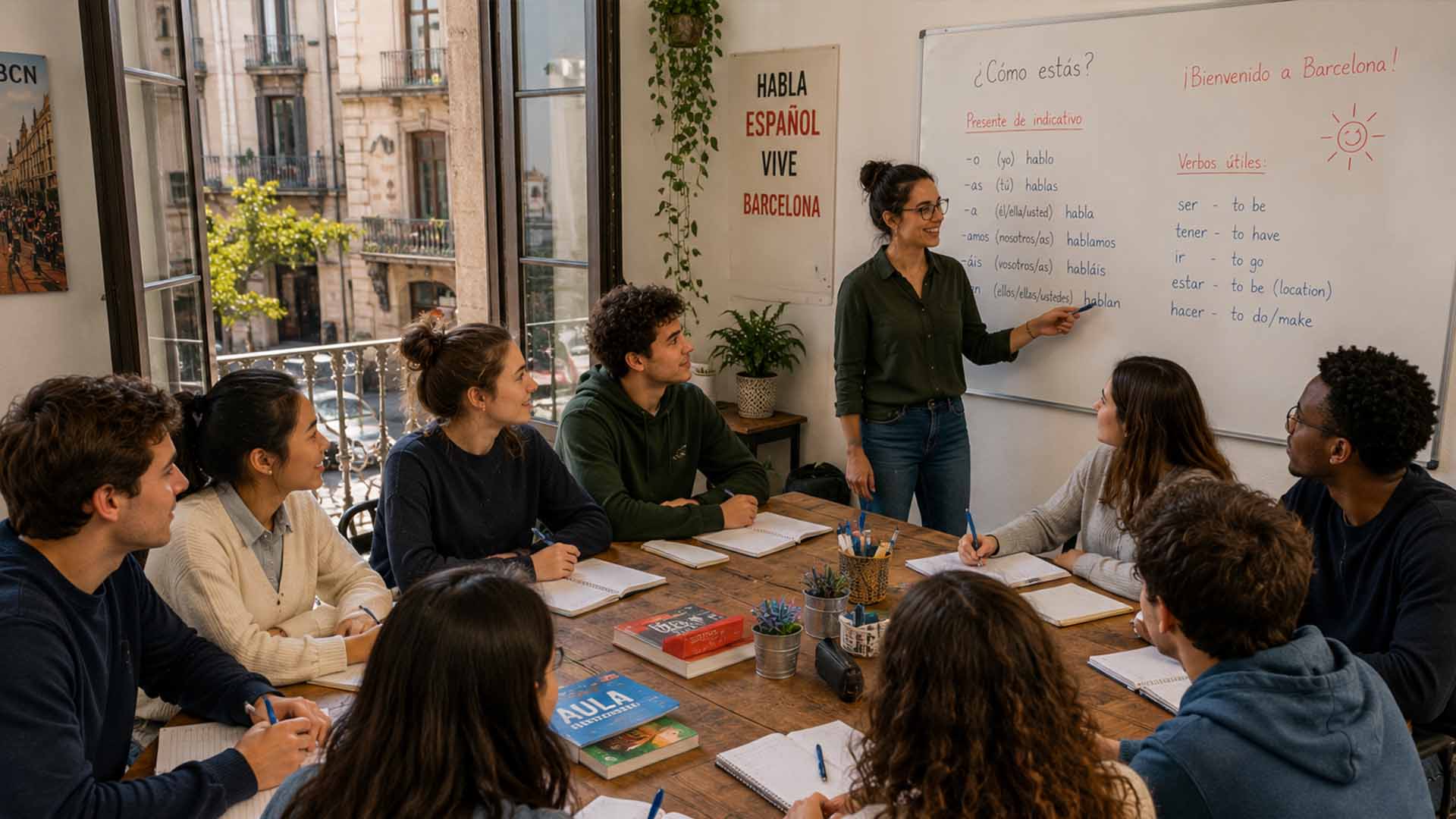
Barcelona, Spain — host city for the Spanish Language course Barcelona, Spain · Barcelona, Spain · Beginners Welcome — ¡Bienvenidos!
Spanish Language Elective

Spanish Language

⏱ Total Hours 45
🎓 Credits 3
📍 Location Barcelona, Spain
✓ Prerequisites None
🇪🇸
Primary Discipline
Spanish Language
Suggested Cross Listings Spanish Studies, European Studies, Cultural Studies
Total Hours 45
Credits 3
Prerequisites / Requirements None

The course provides a formative program, and it is designed for students with no prior experience of Spanish Language. The teacher will explain the fundamental knowledge of grammar, phonetics, morphology and syntax using a functional situational approach (to learn a rule beginning from its location in a text or context). A part of the lesson will be dedicated to real situation exercises, grammar drills, consolidation of the material, deepening of concepts through readings, conversations, role games and listening exercises to correct pronunciation.
UN Sustainable Development Goals Wheel
Language as a foundation for global citizenship

Multilingual competence is a quiet but powerful enabler of the 2030 Agenda. This course supports SDG 4 (Quality Education) by developing communicative literacy and lifelong-learning skills, SDG 10 (Reduced Inequalities) by giving students the linguistic tools to engage authentically with their host community, SDG 11 (Sustainable Cities & Communities) through immersion in Barcelona's everyday life, and SDG 17 (Partnerships for the Goals) through cross-cultural exchange.

4 Key SDGs Addressed
SDG 4: Quality Education SDG 10: Reduced Inequalities SDG 11: Sustainable Cities and Communities SDG 17: Partnerships for the Goals
Understand and use familiar expressions of daily events Communicate clear messages in standard language on familiar topics Introduce yourself and others Talk about personal interests and everyday activities Interact with people in simple situations (e.g., café, restaurant) Manage daily life using basic communication skills

By the end of this course, students will be able to:

1
Recognize and use essential Spanish vocabulary and grammar for daily communication.
Assessment: Quizzes, Midterm Exam, and Final Exam.
2
Engage in basic spoken interactions in everyday situations with appropriate pronunciation.
Assessment: Oral Presentations and Group Project.
3
Understand and respond to simple spoken and written texts in Spanish.
Assessment: Homework Assignments and Quizzes.
4
Demonstrate comprehension and production of short dialogues related to personal and social contexts.
Assessment: Oral Presentations, Midterm Exam, and Final Exam.
5
Apply language skills in authentic community settings such as cafés, markets, and cultural excursions.
Assessment: Group Project and Final Exam.
20%
Engagement and Participation
Active participation in classroom discussions, role plays, and pronunciation exercises. Students demonstrate growing confidence in basic conversational Spanish and intercultural awareness.
LOs 1, 2, 5
10%
Homework Assignments
Regular completion of workbook exercises and online activities reinforcing grammar, vocabulary, and sentence structure.
LOs 1, 3, 4
10%
Quizzes
Two written or oral quizzes assessing grammar comprehension, vocabulary retention, and pronunciation accuracy.
LOs 1, 2, 3
15%
Oral Presentations
Short in-class presentations introducing oneself, describing personal interests, or role-playing real-life scenarios such as ordering food or making travel plans.
LOs 2, 4, 5
15%
Group Project
Collaborative project creating a short video or skit applying learned vocabulary and expressions to daily situations.
LOs 2, 4, 5
15%
Midterm Exam
Combination of oral and written exercises testing comprehension of vocabulary, grammar, and listening skills.
LOs 1, 2, 3, 4
15%
Final Exam
Cumulative oral and written exam demonstrating mastery of beginner-level Spanish and ability to communicate in culturally appropriate ways.
LOs 1, 2, 3, 4, 5
1
Introduction to Spanish Language and PronunciationSpanish alphabet, sounds, greetings, and introductions.
2
Numbers, Dates, and NationalitiesExpressing personal information, basic question words, and country origins.
3
Daily Life VocabularyTalking about family, hobbies, and routine activities using regular verbs.
4
Café and Restaurant ConversationsOrdering food and drinks, using polite expressions, and handling daily transactions.
5
Describing People and PlacesAdjectives, gender and number agreement, physical appearance, and personality.
6
Around the CityVocabulary for transportation, shops, directions, and urban landmarks.
7
Cultural Norms in CommunicationExploring gestures, etiquette, and customs in Spanish-speaking contexts.
8
Grammar Foundations IPresent tense of common verbs (ser, estar, tener, ir) and simple sentence construction.
9
Midterm Review and Oral PracticeFocused activities on comprehension and dialogue.
10
Expressing Likes, Dislikes, and PreferencesUsing gustar and related verbs for everyday interactions.
11
Grammar Foundations IIArticles, prepositions, possessive adjectives, and reflexive verbs.
12
Weather, Time, and ActivitiesDescribing weather, seasons, and making simple plans.
13
Cultural Exploration through Music and FilmListening and comprehension exercises using authentic materials.
14
Preparing for Real-Life InteractionsConversation practice in travel, shopping, and social scenarios.
15
Final Review and Oral ExamIntegration of language skills and cultural reflection.
Out-of-class activities to practice the language (e.g., grocery shopping, ordering food, visiting local markets, using public transportation)
Conversation exchanges with native Spanish speakers for informal language immersion
Visit to a local cultural center, museum, or community event featuring Spanish-language programs
Guest workshop led by a local educator or artist introducing regional dialects or cultural expressions
Guided market activity focused on vocabulary acquisition through experiential learning
Cultural immersion reflection session linking linguistic learning to intercultural competence and SDG 4 (Quality Education) and SDG 17 (Partnerships for the Goals)
Using the city as a classroom is an integral element of education abroad, and this course will include several field visits, as well as assignments that prompt students to engage actively with their host context. Field visits vary across terms, but examples include those listed above.
Books Articles and Reports Films and Recordings
García, Marcial Prado. Practice Makes Perfect: Basic Spanish. McGraw Hill, 2020.
Dorwick, Thalia, and Ana María Pérez-Gironés. Puntos de partida: An Invitation to Spanish. McGraw Hill, 2022.
Spanish Frequency Dictionary: 2500 Most Used Words and Essential Grammar. MostUsedWords, 2021.
Madrigal, Margarita. Madrigal's Magic Key to Spanish. Three Rivers Press, 1989.
Duolingo Spanish — Vocabulary and grammar reinforcement.
BBC Languages: "Spanish Steps" — Beginner-level grammar and listening practice.
SpanishDict — Dictionary, verb conjugation, and pronunciation audio.
FluentU — Immersive learning through Spanish videos and media.
StudySpanish.com — Structured lessons on grammar, pronunciation, and conversation.
Film: "El Laberinto del Fauno" (Pan's Labyrinth) — Selected scenes for cultural comprehension.
Podcast: "Coffee Break Spanish" — Short episodes for practical language learning.
YouTube: "Spanish with Juan" — Conversational Spanish with real-life context.
Music: Beginner-level listening practice through popular Latin and Spanish songs.