
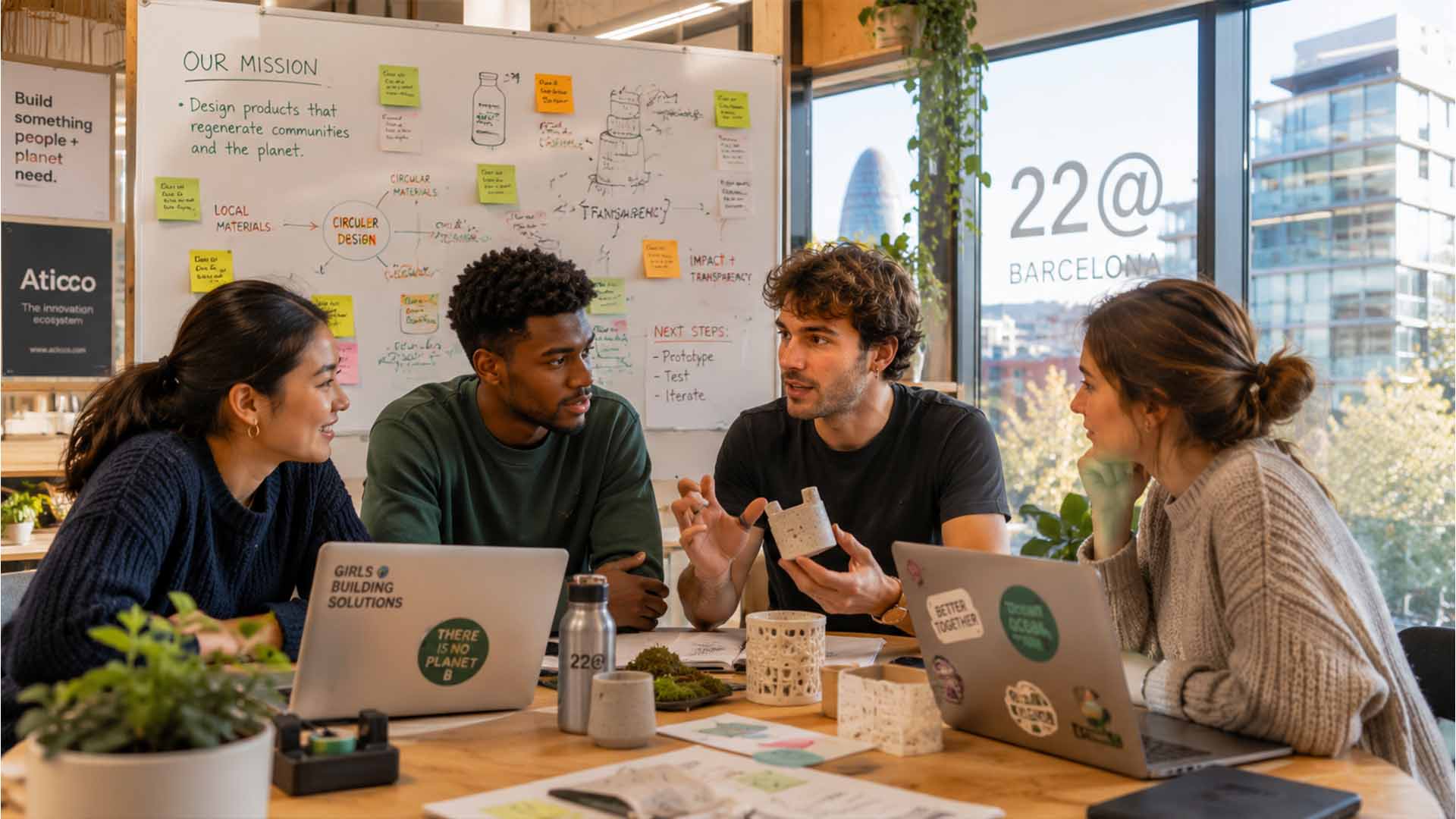
Barcelona, Spain โ€” host city for the Innovation in Action: Project-Based Learning course Barcelona, Spain ยท Project-Based Learning in a Global Context
Entrepreneurship Multi-Program Course

Innovation in Action: Project-Based Learning

โฑ Total Hours 45
๐ŸŽ“ Credits 3
๐Ÿ“ Location Barcelona, Spain
โœ“ Prerequisites None
๐Ÿ’ก
Primary Discipline
Entrepreneurship
Suggested Cross Listings Business, International Studies
Total Hours 45
Credits 3
Prerequisites / Requirements None

Innovation in Action: Project-Based Learning (PBL) is a hands-on course designed to develop NACE Competencies in a global context: exploring the emerging field of social entrepreneurship and innovation while fostering creativity, critical thinking, teamwork, and problem-solving skills. This course will provide a comprehensive overview of how innovation drives sustainable and impactful solutions to social and environmental problems. Through real-world, team-based projects that cultivate leadership, collaboration, communication, and professionalism, students engage with innovation in three essential contexts: 1) public, private, and citizen sectors, 2) social enterprises, and 3) social transformation across entire systems. Students will have the opportunity to apply theories, methodologies, and competencies learned through prior coursework and their experience abroad, developing practical solutions that foster social change on local, national, and international levels.

The European context offers fertile ground for studying innovation. Across the continent, a deep-rooted tradition of craftsmanship, design, and cooperative enterprise continues to intersect with cutting-edge advances in technology, sustainability, and creative industries. Europe remains a global leader in sectors such as fashion, renewable energy, technology, pharmaceuticals, and manufacturing, all while prioritizing human-centered design and social impact.

With a strong legacy of civic engagement and cross-border collaboration, the European Union has cultivated one of the world's most vibrant social and solidarity economiesโ€”supported by cooperatives, foundations, and social enterprises that collectively generate significant contributions to the region's GDP. Within these diverse local, national, and regional contexts, students explore how tradition and innovation coexist and mutually reinforce one another, gaining the skills and perspectives necessary to drive sustainable transformation in the global workforce.

UN Sustainable Development Goals Wheel
Aligned with 5 key UN Sustainable Development Goals

This course advances NACE-aligned career competencies and social entrepreneurship โ€” directly engaging SDG 4 (Quality Education) through experiential learning, SDG 8 (Decent Work and Economic Growth) through social enterprise, SDG 9 (Industry, Innovation and Infrastructure) through design thinking and prototyping, SDG 12 (Responsible Consumption and Production) via sustainable design, and SDG 17 (Partnerships for the Goals) through cross-sector collaboration.

5 Key SDGs Addressed
SDG 4: Quality Education SDG 8: Decent Work and Economic Growth SDG 9: Industry, Innovation and Infrastructure SDG 12: Responsible Consumption and Production SDG 17: Partnerships for the Goals
Social entrepreneurship and innovation NACE competencies in a global context Design thinking and lean startup methodology Systems thinking and problem framing Cross-cultural teamwork and communication Rapid prototyping and user feedback Market research and feasibility studies Scaling, sustainability, and impact measurement Europe's social and solidarity economy Barcelona's innovation ecosystem

By the end of this course, students will be able to:

1
Understand and apply the principles of social entrepreneurship, examining how innovation creates solutions to social and environmental challenges.
Assessment: Team project, individual reflection journal, and final report.
2
Demonstrate proficiency in key NACE competencies in a global context.
Assessment: Peer evaluations and individual reflection journal.
3
Apply principles of design thinking, lean startup, and systems thinking to real-world problems, creating innovative solutions that promote social and environmental impact.
Assessment: Team project milestones and prototypes.
4
Present findings and solutions through professional-level reports, presentations, and prototypes.
Assessment: Final presentation and report.
5
Reflect critically on the role of innovation in society and its potential for driving change.
Assessment: Individual reflection journal and site visit reflections.
20%
Participation, Preparation, and Discussion
Active attendance, demonstrated engagement with assigned readings, and thoughtful contributions to class discussions and group activities.
All LOs
40%
Team Project
Collaborative development of an innovative project throughout the term, requiring progress reports and presentations at key milestones. Includes Proposal (10%), Mid-Term Presentation (10%), and Final Presentation and Report (20%). Engagement with NACE competencies is included in the assessment.
LO 1, 2, 3, 4
20%
Individual Reflection Journal
Ongoing journal documenting personal learning, team dynamics, challenges, and growth. Students critically connect their experiences to NACE competencies and reflect on professional skill development.
LO 2, 5
20%
Site Visit Reflections
Two reports (10% each) connecting observations from field visits to course content, demonstrating applied understanding of innovation in practice.
LO 3, 4, 5
1
Introduction to Innovation & Project-Based LearningOverview of Innovation in Action; the role of project-based learning in the development of creative solutions; introduction to design thinking and project management tools.
2
Understanding and Applying the NACE Competencies in a Global ContextOverview of NACE Competencies and why they matter; intercultural communication and navigating difference.
3
Identifying Problems and Understanding StakeholdersProblem scoping and needs assessment; understanding user and stakeholder perspectives; conducting user interviews and surveys.
4
Idea Generation & BrainstormingTechniques for creative ideation (brainstorming, mind mapping); evaluation of potential solutions and refinement; introduction to rapid prototyping.
5
Prototyping & IterationDesign and development of prototypes (physical, digital, or service-based); lean startup methodology and MVP (Minimum Viable Product); user feedback and iteration.
6
Team Collaboration & CommunicationEffective teamwork and conflict resolution; tools for project management (Trello, Asana, Slack); presentation skills for pitching ideas and progress.
7
Market Research & TestingConducting market analysis and feasibility studies; testing prototypes in real-world environments; collecting data and analyzing feedback.
8
Scaling and ImplementationStrategies for scaling a project or product; considering sustainability, scalability, and impact; cost analysis and budgeting.
9
Final Project DeliveryPreparing the final project report and presentation; communicating project findings to stakeholders and potential investors; peer and self-assessment.
Site visits to innovation hubs, startups, NGOs, and social enterprises that integrate sustainability and social impact
Guest lectures by entrepreneurs, business leaders, and innovation experts
Workshops on design thinking, creative leadership, and impact measurement
Field experiences include site visits to innovation hubs, startups, NGOs, and social enterprises across Barcelona and Catalonia. Class field visits and guest lectures are considered required academic components of the course, and count towards students' participation and engagement grade.
Books Films and Recordings Articles and Reports
Brown, T. Change by Design: How Design Thinking Creates New Alternatives for Business and Society. HarperBusiness, 2009.
Brynjolfsson, Erik, and Andrew McAfee. The Second Machine Age: Work, Progress, and Prosperity in a Time of Brilliant Technologies. New York: W. W. Norton & Company, 2014.
Christensen, Clayton M. The Innovator's Dilemma: When New Technologies Cause Great Firms to Fail. Boston: Harvard Business Review Press, 1997.
Christensen, Clayton M., and Michael E. Raynor. The Innovator's Solution: Creating and Sustaining Successful Growth. Boston: Harvard Business Review Press, 2003.
Harrison, R., and L. Green. Radical Social Innovation: An Emerging Field of Social Change. Springer, 2024.
Hart, Stuart L., and M. A. Sharma. The New Frontiers of Social Innovation: Ideas, Strategies, and Technologies for a Better World. Routledge, 2022.
Kahneman, Daniel. Thinking, Fast and Slow. New York: Farrar, Straus and Giroux, 2011.
Lencioni, Patrick. The Five Dysfunctions of a Team: A Leadership Fable. San Francisco: Jossey-Bass, 2002.
Meyer, Erin. The Culture Map: Breaking Through the Invisible Boundaries of Global Business. New York: PublicAffairs, 2014.
Osterwalder, A., and Y. Pigneur. Business Model Generation: A Handbook for Visionaries, Game Changers, and Challengers. Wiley, 2020.
Ries, Eric. The Lean Startup: How Today's Entrepreneurs Use Continuous Innovation to Create Radically Successful Businesses. Crown Business, 2011.
Sinek, Simon. Leaders Eat Last: Why Some Teams Pull Together and Others Don't. New York: Portfolio, 2014.
Thomas, David C., and Kerr C. Inkson. Cultural Intelligence: Surviving and Thriving in the Global Village. 2nd ed. San Francisco: Berrett-Koehler Publishers, 2009.
Stanford eCorner. 2015. "The Lean Startup Methodology in Action." YouTube video, 15:29.
Stanford Graduate School of Business. 2017. "Design Thinking: How to Start Innovating." YouTube video, 6:09.
TEDx Talks. 2017. "Radical Social Innovation: What It Is and Why It Matters." YouTube video, 14:38.
"Career Competencies: Articulating Transferable Skills Through the Global Experience." My World Abroad. YouTube video.
Javidan, Mansour, David M. Teagarden, and Mary Teagarden. 2012. "Exploring the Intersection of Global Mindset and Global Leadership." Journal of World Business.
Kolk, A., and R. van Tulder. 2019. "Integrating Sustainable Development Goals into Business Strategy." Journal of Business Ethics.
Steers, Richard M., Carlos J. Sanchez-Runde, and Luciara Nardon. 2022. "Understanding and Managing Cross-Cultural Teams in a Global Context." International Journal of Cross-Cultural Management.
Design Thinking for Educators. "Design Thinking for Educators." designthinkingforeducators.com
Harvard Business Review. "Building a Global Leadership Pipeline." hbr.org
NACE (National Association of Colleges and Employers). "Global Competencies." naceweb.org
World Economic Forum. "The 10 Skills You Need to Thrive in the Fourth Industrial Revolution." weforum.org