

Korean Society
Seoul, South Korea · A Society Transformed in a Generation
Course Description
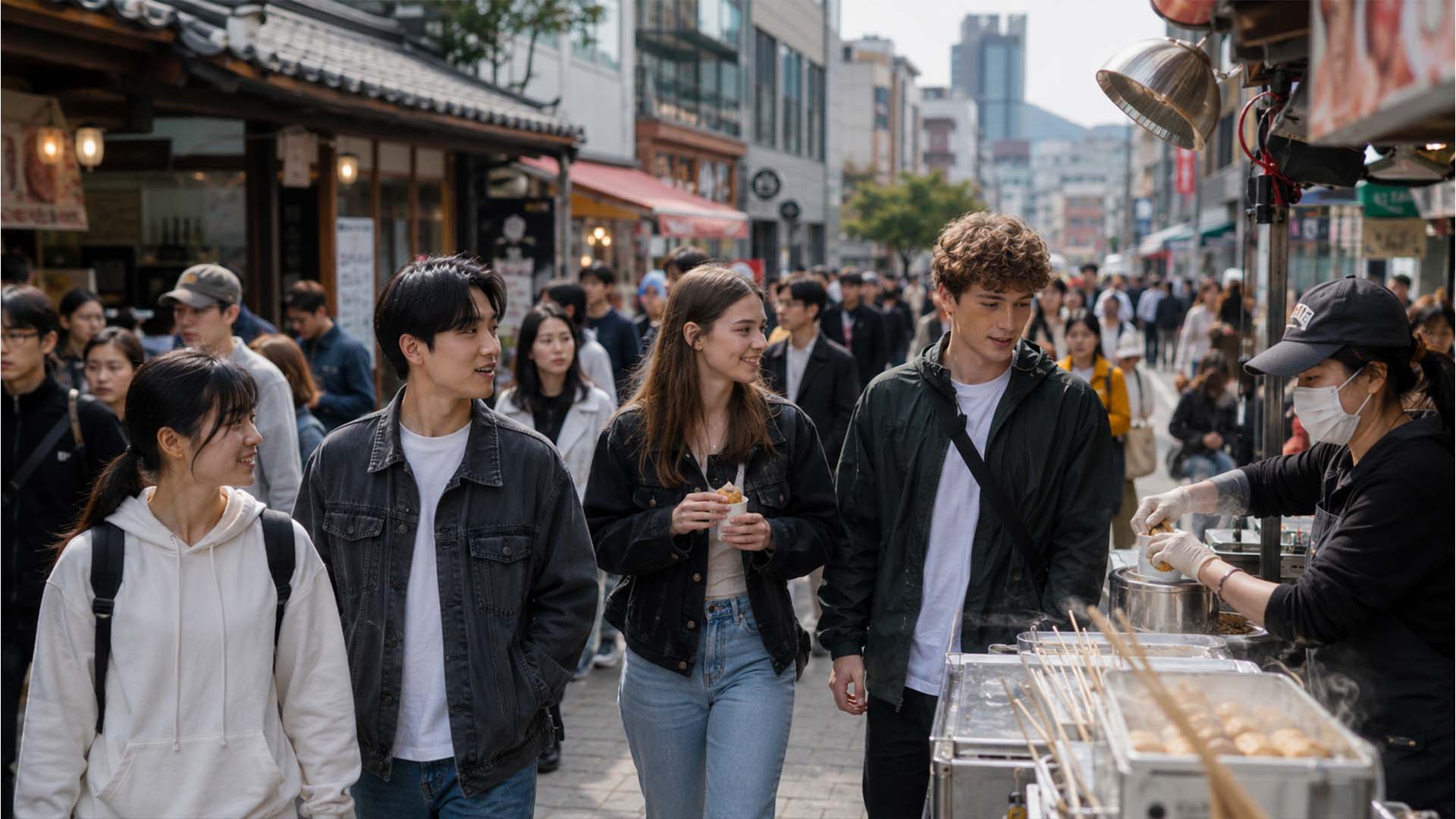
Few societies on earth have changed as rapidly and as visibly as Korean society. In a single lifetime, Korea moved from a rural Confucian society devastated by war to one of the most urbanized, digitized, and educated societies in the world. The institutions of family, gender, education, work, religion, and community have all been remade — and the consequences, from the world's lowest fertility rate to a polarized generational politics to the global Korean Wave, are reshaping both Korea and the way the world looks at it.
This course offers a sociological introduction to contemporary Korean society. Drawing on Korean sociologists, anthropologists, and journalists — and using Seoul itself as the primary fieldwork site — students examine the structures and lived experiences of Korean life today. The course is suitable for students from any discipline; it is designed to give students sophisticated, current, and empathetic understanding of Korean social reality.
Aligned with the UN Sustainable Development Goals
Korean society is engaging — sometimes painfully — with several of the SDGs simultaneously. This course addresses SDG 4 (Quality Education), SDG 5 (Gender Equality), SDG 10 (Reduced Inequalities), SDG 11 (Sustainable Cities and Communities), and SDG 3 (Good Health and Well-Being, especially mental health).
Key Topics
Learning Objectives
By the end of this course, students will be able to:
-
Describe the major institutions of Korean society — family, education, work, religion — and how they have transformed over the past sixty years.
Assessment: Assessment: Short institutional analysis paper.
-
Analyze contemporary Korean gender dynamics, including the rise of Korean feminism and the gender backlash, with empirical and theoretical grounding.
Assessment: Assessment: Gender case-study analysis.
-
Apply sociological frameworks to a major contemporary Korean social challenge — fertility decline, educational pressure, mental health, or youth precarity.
Assessment: Assessment: Sociological analysis paper.
-
Conduct a small-scale ethnographic observation in Seoul — a public space, an institution, or a community — and analyze it with sociological tools.
Assessment: Assessment: Ethnographic field report.
-
Articulate a critical, empathetic, and current understanding of Korean society that goes beyond stereotype and surface narrative.
Assessment: Assessment: Final synthesis essay.
Course Format and Assessment Methods
Total grade is composed of the following weighted components:
Course Outline
The course is organized into the following sessions, which may be combined or expanded depending on summer vs. semester format.
-
Why Korean SocietyCourse framing: why Korean society is one of the world's most consequential sociological case studies.
-
The Korean Family in TransformationFrom the patrilineal Confucian household to the contemporary Korean family — and the world's lowest fertility rate.
-
Education and Exam CultureThe hagwon system, the Suneung exam, and the social costs of educational competition.
-
Work and the Salary-Man SystemKorean workplace culture, hierarchy, drinking culture, and the slow shifts driven by younger generations.
-
Gender I: From Confucianism to Constitutional EqualityThe long arc of gender in Korea — and the institutional gains of the post-democratization period.
-
Gender II: Korean Feminism and the BacklashThe post-2015 feminist wave, MeToo in Korea, and the contemporary gender backlash among young men.
-
Religion in Contemporary KoreaChristianity (Protestant and Catholic), Buddhism, shamanism, and the rising share of the religiously unaffiliated.
-
Generations: Defining the 2030sGenerational divides, the MZ cohort, and the politics of generation.
-
Mental Health and the Suicide CrisisKorea's suicide and mental health crisis — causes, social responses, and the limits of medicalization.
-
Youth PrecarityEmployment, housing, and the futures Korean young adults can and can't imagine.
-
Migration and the New Korean CitizenKorean diaspora returns, immigrant workers, marriage migrants, and the slow emergence of a multicultural Korea.
-
Urban Korea: Seoul's DominanceThe metropolitan concentration, regional decline, and what "Seoul-as-Korea" does to the rest of the country.
-
Digital SocietyThe most digitally connected society in the world — and what that connection does to social life.
-
Capstone DiscussionFinal synthesis discussion and student presentations.
Field Visits and Guest Speakers
Seoul is the city as classroom. Course-related field components vary by term and availability, but examples include:
- Walking observation of a Seoul neighborhood — Gangnam, Hongdae, or Mullae-dong — with structured sociological prompts.
- Visit to a Korean hagwon district (Daechi-dong) and a conversation with parents and educators.
- Visit to a Seoul women's NGO or feminist cultural space.
- Visit to a major Korean Protestant megachurch and a Buddhist temple — comparative observation.
- Seminar at the Korean Women's Development Institute or the Korea Institute of Public Administration.
- Day visit to a regional Korean city (Cheongju, Daegu, or a coastal town) for contrast with Seoul.
Readings & Resources
Selected readings and resources for this course. Full syllabus and reading list provided at enrollment.
Books
Abelmann, Nancy. The Melodrama of Mobility: Women, Talk, and Class in Contemporary South Korea. University of Hawai'i Press, 2003.
Cho, Han Hae-joang. Reading Texts, Reading Lives in the Era of Neo-Liberalism. Seoul: Tto Hanaui Munhwa, 2007.
Cho, Nam-joo. Kim Jiyoung, Born 1982. Translated by Jamie Chang. New York: Liveright, 2020.
Eckert, Carter J., and Christine M. Yano, eds. Modern Korea: A Very Short Introduction. Oxford University Press, 2024.
Kendall, Laurel. Shamans, Nostalgias, and the IMF: South Korean Popular Religion in Motion. University of Hawai'i Press, 2009.
Park, Jin-Kyung. Korean Modernity and the Birth of the Asian Tiger. Routledge, 2020.
Films and Recordings
Bong, Joon-ho, dir. 2019. Parasite.
Hwang, Dong-hyuk, dir. 2021. Squid Game. Netflix.
Lee, Chang-dong, dir. 2018. Burning.
Articles and Reports
Cho, Joo-hyun. 2018. "Intersectional Feminism and the 'Megalia' Phenomenon." Korean Journal of Sociology.
Korean National Statistical Office. 2024. Population Trends Annual Report.
Lee, So Jung. 2019. "South Korea's Demographic Time Bomb." Asian Affairs.
OECD. 2024. OECD Family Database: Korea.
Park, Eun-Cheol. 2023. "Mental Health and Suicide in Korea." Lancet Regional Health.
Yang, Jae-jin. 2017. "The Political Economy of the Korean Welfare State." Journal of East Asian Studies.