

Korean Culture
Seoul, South Korea · Heritage, Identity & Creative Confidence
Course Description
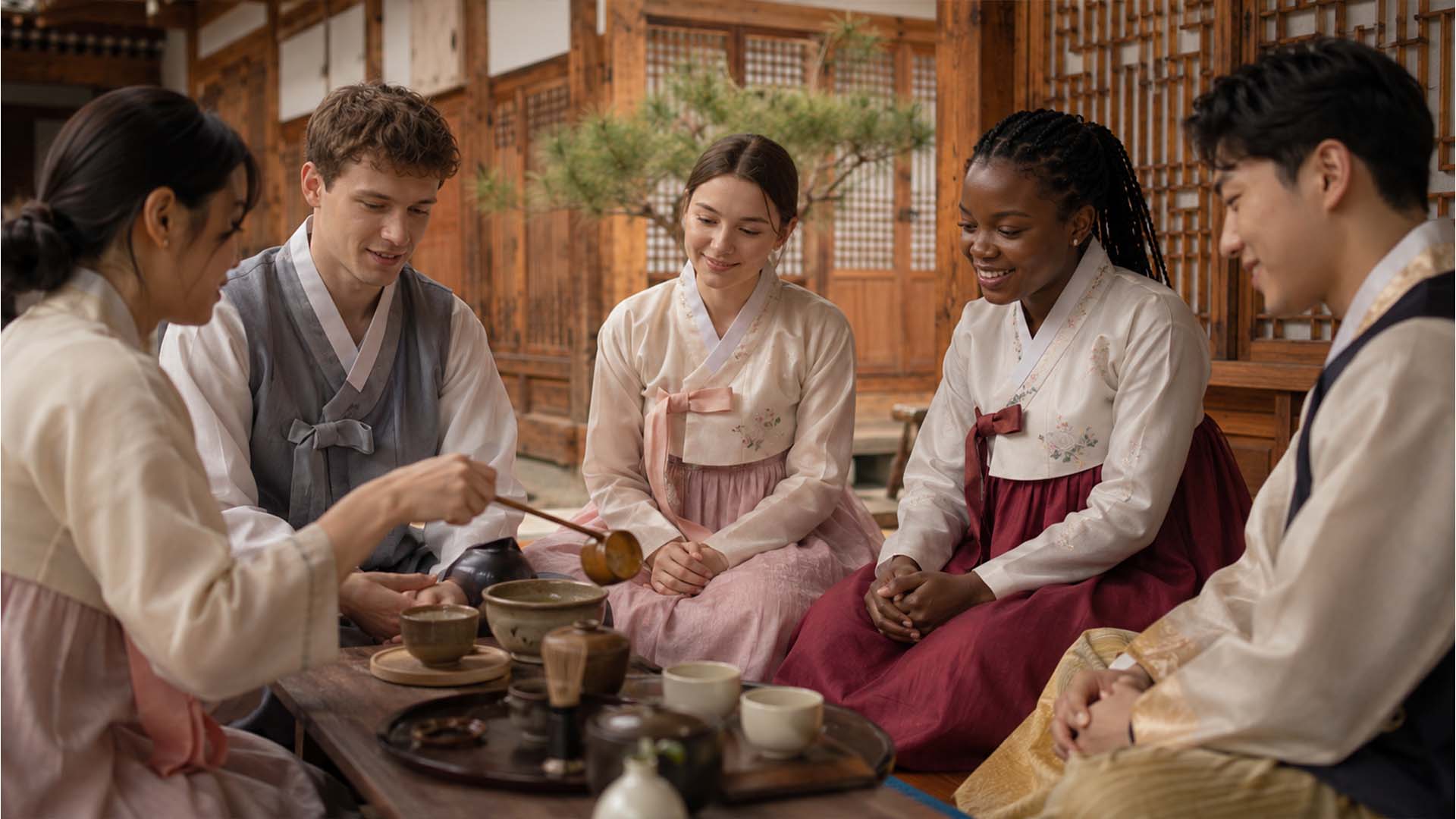
To know Korea is to know its culture — not as a fixed essence but as a living, contested, evolving tradition that has shaped, and been shaped by, every era of Korean history. From the philosophical foundations of Confucianism and Buddhism through the everyday practices of food, dress, and ritual, to the contemporary creative explosion of K-pop, K-drama, and Korean cinema, Korean culture rewards close, sustained study.
This course offers a thematic introduction to Korean culture, organized around the institutions, practices, and aesthetics that give Korean life its texture. Students engage directly with Korean cultural sites in Seoul — museums, palaces, temples, traditional markets, contemporary art spaces — and develop both analytical frameworks and lived familiarity with Korean cultural traditions. The course is designed for students from any discipline who want to engage with Korea beyond its economic and political headlines.
Aligned with the UN Sustainable Development Goals
Cultural literacy is foundational to several SDGs — SDG 4 (Quality Education), SDG 11 (Sustainable Cities and Communities, especially heritage), SDG 17 (Partnerships for the Goals), and SDG 5 (Gender Equality, through the lens of cultural representation).
Key Topics
Learning Objectives
By the end of this course, students will be able to:
-
Identify and contextualize the foundational philosophical, religious, and aesthetic traditions of Korean culture.
Assessment: Assessment: Foundations response paper.
-
Analyze a specific Korean cultural practice — culinary, religious, artistic, or performative — through both historical and contemporary lenses.
Assessment: Assessment: Cultural practice analysis.
-
Engage critically with the Korean Wave (Hallyu) as both a creative achievement and a strategically constructed cultural export.
Assessment: Assessment: Hallyu critical essay.
-
Reflect on the experience of cultural immersion in Seoul — interpreting personal observations through course frameworks.
Assessment: Assessment: Reflective fieldnotes and integrative essay.
-
Develop a sophisticated, evidence-based account of contemporary Korean cultural identity that resists stereotype and surface narrative.
Assessment: Assessment: Final synthesis project.
Course Format and Assessment Methods
Total grade is composed of the following weighted components:
Course Outline
The course is organized into the following sessions, which may be combined or expanded depending on summer vs. semester format.
-
Approaching Korean CultureCourse framing: culture as practice, not essence — and the questions worth asking about any cultural tradition.
-
Confucian FoundationsNeo-Confucianism in Joseon and its enduring influence on Korean family, education, work, and ethics.
-
Buddhist KoreaKorean Buddhism: Seon (Zen) practice, monastic life, temple culture, and contemporary Korean Buddhist identity.
-
Shamanism and Folk ReligionKorean shamanism (musok), folk belief, and the religious practices that often go unmentioned in official narratives.
-
Hangeul: A Designed AlphabetKing Sejong's invention of hangeul, its phonetic logic, and its political meaning then and now.
-
Korean CuisineThe long history of Korean food, regional variation, kimchi as cultural practice, and the contemporary Korean culinary moment.
-
Hanbok, Hanok, and Korean AestheticsTraditional Korean dress and architecture, the aesthetic principles underlying them, and their contemporary reinterpretation.
-
Korean Traditional MusicCourt music, folk music, pansori, and the contemporary preservation and reinterpretation of musical heritage.
-
Korean Visual ArtJoseon ink painting, the modern art movement, the contemporary biennial scene, and Korean artists on the global stage.
-
Korean FilmKorean New Wave, the global rise of Korean cinema, and the cultural specificity of films like Parasite, Burning, and Memories of Murder.
-
Korean Television and DramaK-drama as cultural form, narrative conventions, and global reception.
-
K-pop and Popular MusicK-pop as system: idols, agencies, fan culture, and the global music economy.
-
Hallyu as Strategic ExportKorean state cultural policy, the construction of Hallyu, and its political-economic dimensions.
-
Capstone DiscussionFinal synthesis discussions and project presentations.
Field Visits and Guest Speakers
Seoul is the city as classroom. Course-related field components vary by term and availability, but examples include:
- Visit to the National Museum of Korea and the National Folk Museum of Korea.
- Guided visit to Bongeunsa Temple in Gangnam and Jogyesa Temple in central Seoul.
- Cultural workshop on hanbok, calligraphy, or traditional Korean tea.
- Visit to the Leeum, Samsung Museum of Art, and one Seoul contemporary gallery.
- Guided visit to a traditional Korean market (Gwangjang or Tongin) with culinary framing.
- Visit to the K-pop and entertainment district — HYBE Insight, SM Town, or JYP studios (where access permits).
Readings & Resources
Selected readings and resources for this course. Full syllabus and reading list provided at enrollment.
Books
Buswell, Robert E., Jr. The Zen Monastic Experience: Buddhist Practice in Contemporary Korea. Princeton: Princeton University Press, 1992.
Deuchler, Martina. The Confucian Transformation of Korea: A Study of Society and Ideology. Cambridge, MA: Harvard University Asia Center, 1992.
Han, Kyung-Koo. The Anthropology of the Discourse on the Koreanness of Koreans. Korea Journal, 2003.
Howard, Keith. Korean Music: Tradition and Transformation. Routledge, 2022.
Kendall, Laurel. Shamans, Nostalgias, and the IMF. University of Hawai'i Press, 2009.
Pettid, Michael J. Korean Cuisine: An Illustrated History. London: Reaktion, 2008.
Films and Recordings
Bong, Joon-ho, dir. 2019. Parasite.
Im, Kwon-taek, dir. 1993. Sopyonje.
Lee, Chang-dong, dir. 2010. Poetry.
Various artists. K-pop: BTS, BLACKPINK, NewJeans, IVE — selected music videos and performances.
Articles and Reports
Jin, Dal Yong. 2016. New Korean Wave: Transnational Cultural Power in the Age of Social Media. University of Illinois Press (excerpts).
Korean Cultural Heritage Administration. 2024. Annual Report on Korean Heritage.
Lie, John. 2012. "What Is the K in K-pop? South Korean Popular Music, the Culture Industry, and National Identity." Korea Observer.
Park, Sang-Mi. 2020. "The Politics of Korean Cultural Heritage." Journal of Korean Studies.
Walraven, Boudewijn. 2019. "Popular Religion in Korea: A Comprehensive Account." Religion Compass.