

Introduction to Korean Politics
Seoul, South Korea · Democracy, Diplomacy & the DMZ
Course Description
South Korean democracy is one of the great political achievements of the late twentieth century — and one of the most consequential test cases for democratic governance in the twenty-first. In a single generation, Koreans built a robust electoral democracy, a vigorous civil society, and a state capable of impeaching presidents while remaining a frontline ally in one of the world's most dangerous strategic theaters. This course offers an introduction to that political system — its institutions, its parties, its civil society, and its foreign policy — alongside the geopolitical environment in which it operates.
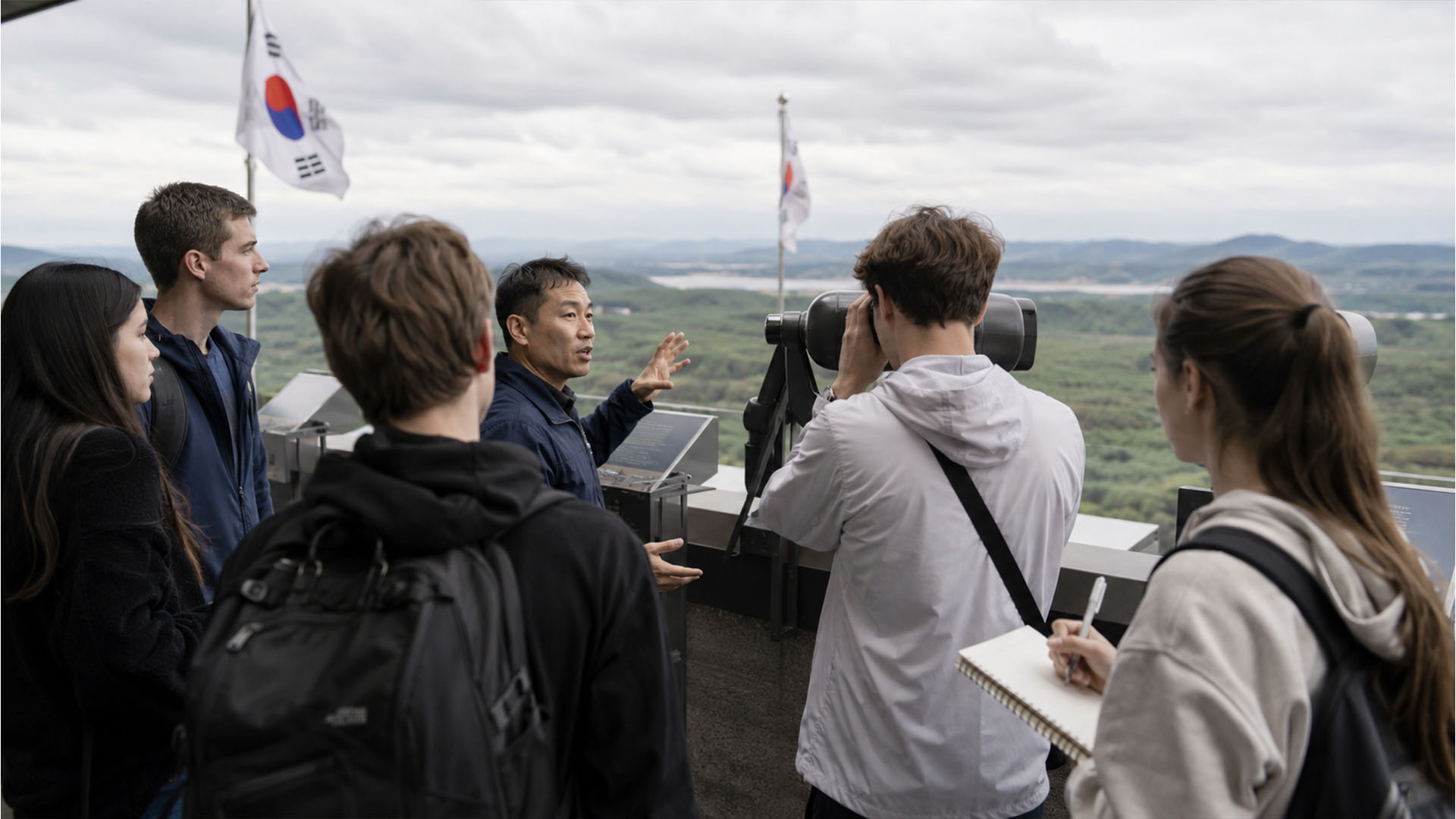
Set in Seoul, with the National Assembly, Blue House, and DMZ all within reach, the course combines classroom analysis with direct exposure to Korean political institutions and actors. Students engage with Korean political scientists, journalists, and practitioners, and develop the analytical tools to read Korean politics, US-ROK relations, and Indo-Pacific security with confidence.
Aligned with the UN Sustainable Development Goals
This course engages most directly with SDG 16 (Peace, Justice and Strong Institutions) and SDG 17 (Partnerships for the Goals), with secondary engagement with SDG 5 (Gender Equality) and SDG 10 (Reduced Inequalities) through the lens of Korean political dynamics.
Key Topics
Learning Objectives
By the end of this course, students will be able to:
-
Describe the constitutional and institutional architecture of the Republic of Korea, and analyze how power is distributed, contested, and exercised.
Assessment: Assessment: Short institutional analysis paper.
-
Analyze Korean party politics and electoral behavior, including the role of region, generation, and gender in shaping voting and governance.
Assessment: Assessment: Election case-study analysis.
-
Evaluate Korean civil society's role in democratization and contemporary politics, including the 2016–17 candlelight protests and impeachment.
Assessment: Assessment: Research paper on a specific civil-society movement.
-
Analyze inter-Korean relations and Korean foreign policy toward the US, China, Japan, and the wider Indo-Pacific.
Assessment: Assessment: Foreign policy memo.
-
Apply political analysis to a current Korean policy debate, integrating institutional, social, and international dimensions.
Assessment: Assessment: Final research paper and presentation.
Course Format and Assessment Methods
Total grade is composed of the following weighted components:
Course Outline
The course is organized into the following sessions, which may be combined or expanded depending on summer vs. semester format.
-
Why Korean PoliticsCourse framing: Korean democracy as both achievement and ongoing experiment.
-
The Sixth RepublicConstitutional design after 1987 — presidency, National Assembly, Constitutional Court.
-
The Korean PresidencyPresidential powers, the imperial-presidency critique, and the cycle of presidential downfall.
-
The National AssemblyElectoral systems, parliamentary practice, and the politics of legislation.
-
Parties and Party SystemsThe Democratic / People Power binary, party fragmentation and reconstitution, and the role of regional cleavages.
-
Civil Society and Korean DemocracyThe democratization movement, the 2016–17 candlelight protests, and the institutional consequences of mass mobilization.
-
Gender and Generation in Korean PoliticsFeminist movements, the gender backlash, generational polarization, and the politics of youth precarity.
-
North Korea: Threat and InterlocutorThe DPRK's political system, nuclear program, succession politics, and the puzzle of dialogue.
-
Inter-Korean RelationsEngagement, sanctions, and the long history of inter-Korean diplomacy from Kim Dae-jung through Moon Jae-in to the present.
-
The US-ROK AllianceHistory, mechanics, current strains, and the alliance's future in the era of strategic competition.
-
Korea, Japan, and ChinaBilateral dynamics, historical legacies, and the trilateral architecture of Northeast Asia.
-
Indo-Pacific StrategyKorea's posture in the broader Indo-Pacific — from Moon's New Southern Policy to Yoon's strategic clarity.
-
Korea as a Global Middle PowerKorean development assistance, Korean diplomacy in the G20 and OECD, and the global Korea brand.
-
Capstone: Research PresentationsFinal research-paper presentations.
Field Visits and Guest Speakers
Seoul is the city as classroom. Course-related field components vary by term and availability, but examples include:
- Visit to the National Assembly in Yeouido, including (when possible) attendance at a parliamentary session.
- Guided tour of the former Blue House (Cheong Wa Dae) and Seoul's political district.
- Day-long DMZ and Joint Security Area visit with security and policy framing.
- Seminar at the Korea Institute for National Unification (KINU) or the Asan Institute for Policy Studies.
- Guest lecture from a Korean political scientist, journalist, or former senior official.
- Visit to the May 18 Memorial in Gwangju (semester-length variant) or the June Democracy Movement memorial in Seoul.
Readings & Resources
Selected readings and resources for this course. Full syllabus and reading list provided at enrollment.
Books
Cha, Victor D. The Impossible State: North Korea, Past and Future. New York: Ecco, 2012.
Heo, Uk, and Terence Roehrig. South Korea's Rise: Economic Development, Power, and Foreign Relations. Cambridge: Cambridge University Press, 2014.
Kim, Sunhyuk. The Politics of Democratization in Korea: The Role of Civil Society. Pittsburgh: University of Pittsburgh Press, 2000.
Lankov, Andrei. The Real North Korea: Life and Politics in the Failed Stalinist Utopia. Oxford: Oxford University Press, 2013.
Saxer, Carl J. From Transition to Power Alternation: Democracy in South Korea, 1987–1997. Routledge, 2002.
Snyder, Scott A. South Korea at the Crossroads: Autonomy and Alliance in an Era of Rival Powers. New York: Columbia University Press, 2018.
Films and Recordings
BBC. 2023. Inside South Korea's Political Earthquake.
Frontline. 2018. The Secret State of North Korea. PBS.
Lee, Joon-ik, dir. 2017. I Can Speak.
Articles and Reports
Cha, Victor D. 2009. "Powerplay: Origins of the U.S. Alliance System in Asia." International Security.
Han, Sang-Hee. 2018. "Candlelight Revolution and South Korean Democracy." Journal of Korean Studies.
Kim, Hyung-A. 2024. "Yoon Suk-yeol's Foreign Policy and the US-ROK Alliance." Asian Survey.
Korea Institute for National Unification. 2024. White Paper on Korean Unification.
Snyder, Scott A. 2024. "South Korea's Indo-Pacific Strategy." Council on Foreign Relations.