

Program Overview
India is home to nearly 18% of the world’s population and faces a profound paradox: it is one of the world’s major food producers, yet also one of its most food-insecure nations, with over 194 million people undernourished according to the UN’s State of Food Security report. This program, delivered for the University of Sydney, provided students with a comprehensive, on-the-ground understanding of food justice as a multifaceted issue encompassing legal frameworks, agricultural policy, biodiversity conservation, and social equity in the world’s largest democracy.
Students engaged directly with grassroots organization’s, policy institutes, seed sovereignty advocates, and community food initiatives to explore how India’s constitutional right to food translates — or fails to translate — into practice through farmer movements, community seed banks, and innovative food distribution systems.
Through immersive cultural experiences in agricultural heartlands and urban centers, students encountered traditional farming practices, participated in community kitchens, and explored local food markets. These experiences developed skills in policy analysis, community engagement, and cross-cultural understanding, while deepening each student’s identity as a global citizen committed to social justice and sustainable development.
Key Program Elements
Gain key insights into India’s Food Systems, Policy and Social Justice.
- Explore India’s constitutional right to food and the Public Distribution System (PDS) through lectures and a first-hand ration shop visit.
- Engage with seed sovereignty advocates and community seed banks to understand the role of indigenous varieties in food security and biodiversity.
- Interact with grassroots organization’s and academic experts working at the intersection of food justice, gender equity, and social policy.
- Examine how India’s largest mid-day meal program — Akshaya Patra — addresses classroom hunger at scale.
Build skills to engage with food systems, policy, and sustainable development.
- Develop analytical skills by engaging with NGOs, academic institutions, and community organization’s addressing food justice challenges.
- Reflect on the tensions between food production, food access, and social equity in a rapidly developing economy.
- Apply cross-cultural and policy analysis skills directly relevant to careers in international development, public policy, and sustainability.
- Understand how colonial legacies, gender dynamics, and indigenous knowledge systems shape contemporary food justice movements.
Hands-on Experience of Indian Culture and Food Heritage
- Explore traditional marketplaces — Malleswaram in Bengaluru and Devaraja Market in Mysuru — experiencing India’s vibrant food culture firsthand.
- Visit cultural and spiritual sites including Mysuru Palace, Namdroling Monastery, and Chamundi Hills Temple.
- Participate in a professional cooking workshop at Slurp Culinary Academy and a guided food tour of Malleswaram.
- Experience Bengaluru’s cosmopolitan food culture and Mysuru’s heritage city atmosphere across two contrasting urban settings.
Which UN SDGs does this program advance?
SDG 1: No Poverty
- Explores how food justice intersects with poverty alleviation through visits to organization’s working on rural development and equitable food distribution.
- Students examine social protection schemes like the Public Distribution System and their impact on reducing poverty among vulnerable communities.
SDG 2: Zero Hunger
- Students engage directly with food security systems, community kitchens, and policy frameworks that address hunger and malnutrition.
- Through visits to seed banks and agricultural organizations, students understand sustainable food production and its role in achieving food security for India’s diverse populations.
SDG 5: Gender Equality
- Students interact with women-led food security initiatives and organization’s that highlight the central role of women in agriculture and food systems.
- They explore how gender-responsive policies and women’s empowerment contribute to more equitable food access and agricultural sustainability.
SDG 10: Reduced Inequalities
- The program examines how food justice movements address social, economic, and regional inequalities in food access.
- Students learn about policy interventions and grassroots initiatives that work to ensure equitable food distribution across India’s diverse socioeconomic landscape.
SDG 15: Life on Land
- Through engagement with biodiversity organizations and community seed banks, students understand the critical relationship between agricultural biodiversity and traditional ecological knowledge.
- Students explore sustainable land use practices that preserve India’s rich biological heritage while ensuring food security.
Program Highlights
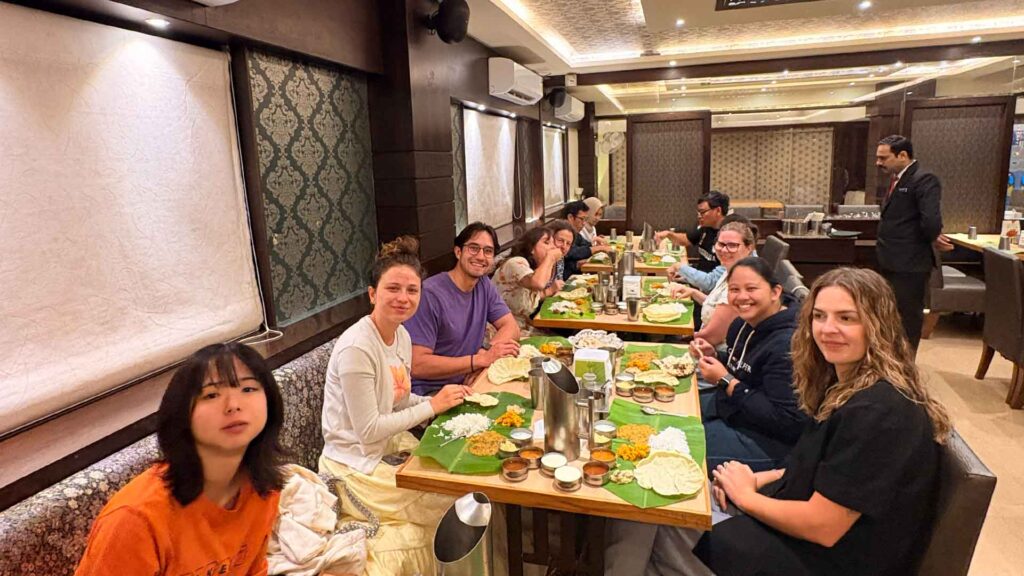
Malleswaram Food Tour
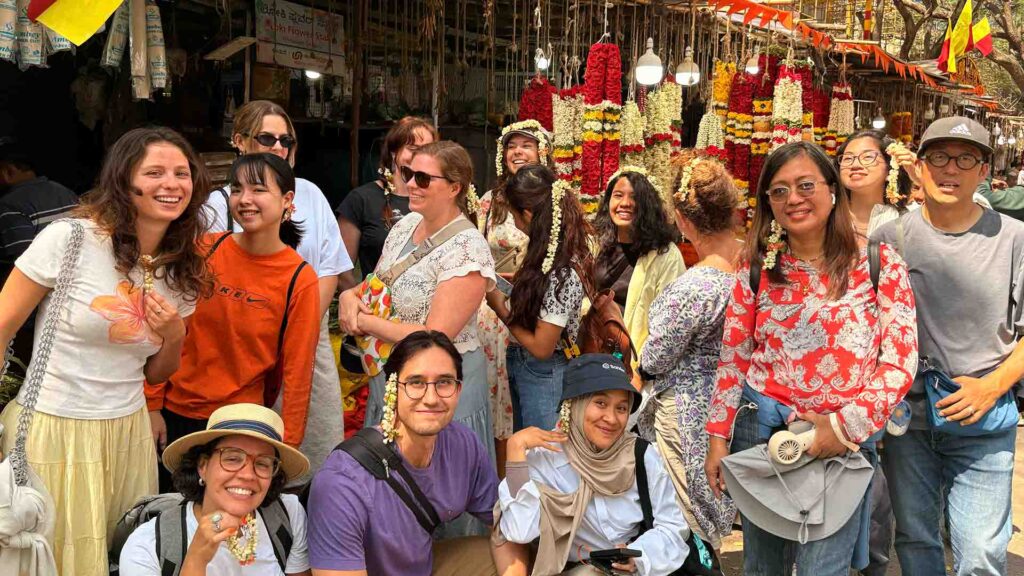
Ration Shop Visit
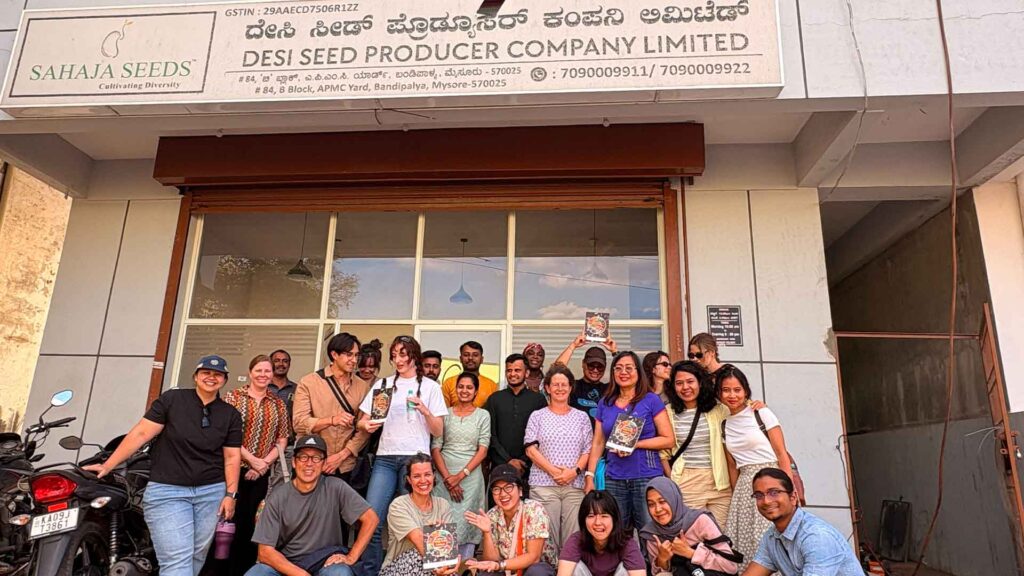
Hariyalee Seeds
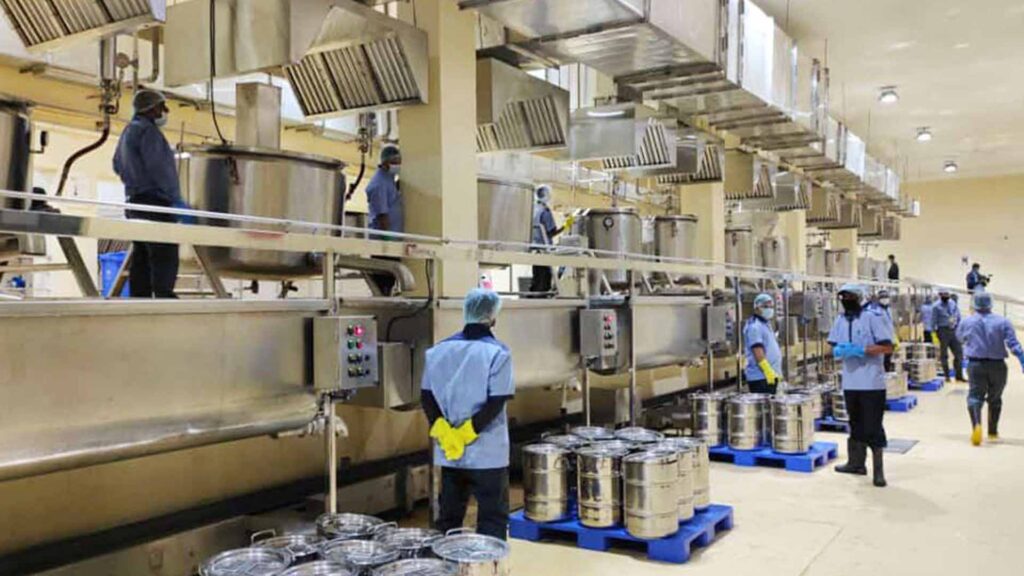
Akshaya Patra Kitchen
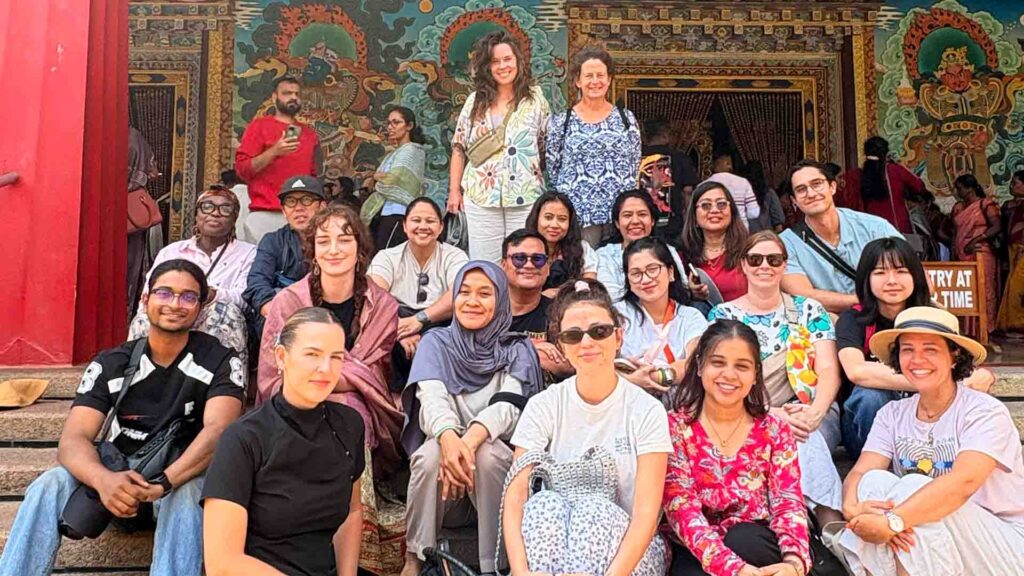
Namdroling Monastery
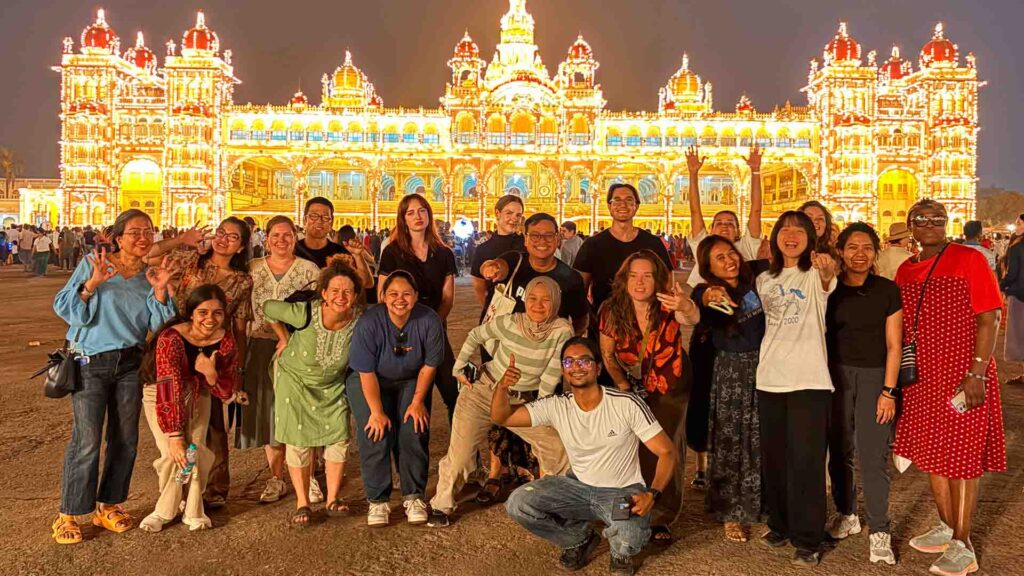
Mysuru Palace
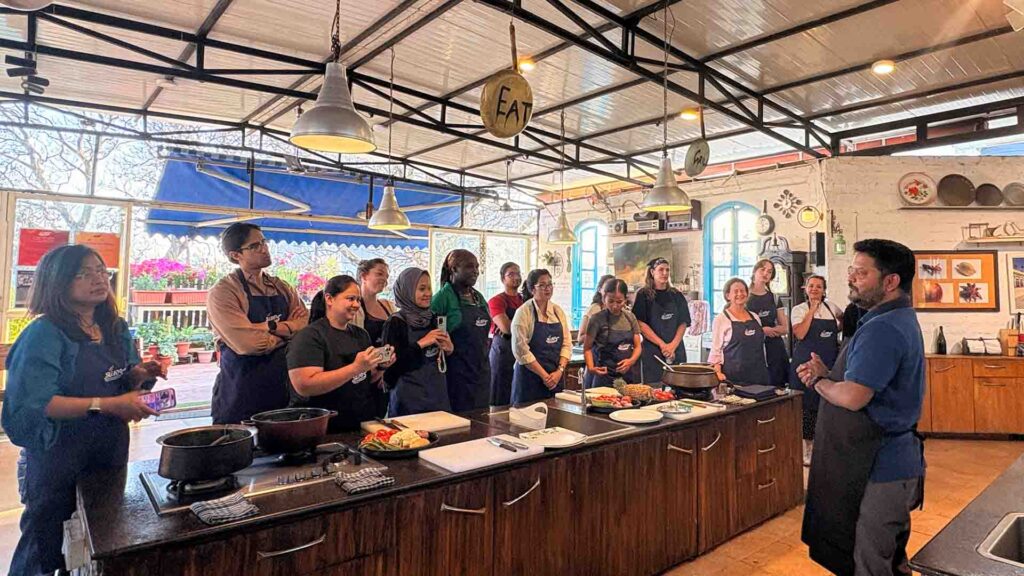
Cooking Workshop
What will you learn?
(Learning outcomes)
Food Systems & Policy Analysis
Understand how India’s constitutional right to food translates into practice — examining the Public Distribution System, legal frameworks, and the gap between policy and grassroots reality.
Skills Developed:
Policy Analysis, Critical Thinking
Seed Sovereignty & Biodiversity
Explore the role of indigenous seed conservation, natural farming, and agricultural biodiversity in building resilient, equitable food systems.
Skills Developed:
Sustainability Literacy, Systems Thinking
Cross-Cultural & Community Engagement
Build the ability to engage meaningfully with diverse communities — farmers, activists, academics, and NGO leaders — across two contrasting Indian cities.
Skills Developed:
Cultural Sensitivity, Community Engagement
Social Justice & Global Citizenship
Connect food insecurity to broader structures of inequality — caste, gender, region, and colonial legacy — and reflect on your own role as a global citizen committed to sustainable development.
Skills Developed:
Social Justice Awareness, Reflective Practice
Sample Itinerary
Day 1: Arrival & Welcome
- Arrival at Kempegowda International Airport, Bengaluru — check-in to hotel
- Evening: Orientation & safety briefing, neighborhood walk
- Welcome dinner at Brooks and Bonds Brewery
Day 2: Food Tour + PDS Lecture + Ration Shop Visit
- Early morning: Guided food tour of Malleswaram — Death by Dosa
- Afternoon: Lecture on India's Public Distribution System
- Afternoon: First-hand visit to a local ration shop (PDS)
- Evening: Dinner at Nagarjuna
Day 3: Hariyalee Seeds + Cooking Workshop
- Full day: Visit to Hariyalee Seeds — indigenous seed conservation, natural vs. organic farming, revival of traditional seed varieties
- Evening: Cooking workshop & dinner at Slurp Culinary Academy
Day 4: Guest Lecture + Bollywood Dance Workshop
- Full day: Guest lecture on constitutional right to food, legal frameworks, and public distribution
- Evening: Bollywood dance workshop
Day 5: Transfer to Mysuru + Sahaja Seeds + Chamundi Hills
- Morning: Transfer to Mysuru
- Afternoon: Check-in; lunch
- Late afternoon: Visit to Sahaja Seeds — community-driven seed farming
- Evening: Guided visit to Chamundeshwari Temple, Chamundi Hills
Day 6: Namdroling Monastery
- Full day: Visit Namdroling Monastery — Buddhist philosophy, sustainable living & Tibetan cultural preservation
- Evening: Free time
Day 7: Mysuru Palace + Srirangapatnam + Devaraja Market
- Full day: Cultural immersions — Mysuru Palace & Srirangapatnam Temple
- Evening: Guided visit to Devaraja Market
Day 8: Return to Bengaluru + Green Foundation
- Morning: Transfer back to Bengaluru
- Afternoon: Visit Green Foundation — biodiversity conservation & community empowerment
- Evening: Hotel check-in
Day 9: Akshaya Patra + ISKCON Temple + Farewell Dinner
- Early morning: Akshaya Patra mega-kitchen visit
- Morning: Akshaya Patra Foundation HQ
- Afternoon: ISKCON Temple
- Evening: Farewell dinner at The Reservoir
Day 10: Departure
- Check-out and group transfer to Kempegowda International Airport
*Please note that the itinerary is a sample guide and is subject to possible modifications.
How much does the program cost?
- *COST: A$1,814 – A$2,245 / PERSON
(Twin-sharing basis; based on group size — see table below)
*Please note that the cost of our programs may vary depending upon several factors, including but not limited to the size of the group, program inclusions, the number of program days and more. Kindly contact us for a customised quote that suits your specific requirements.
| Group Size | 12–15 participants | 16–19 participants | 20–25 participants |
|---|---|---|---|
| Cost per participant (twin-share) | A$2,245 | A$1,973 | A$1,814 |
| Single supplement (add to above) | A$430 | ||
What's Included
- Accommodation (bed & breakfast, Wi-Fi) for 9 nights
- 9 breakfasts, 3 lunches & 4 dinners
- Airport transfers & all-in-country transport (private AC coach)
- 24×7 on-ground support by Authentica Program Manager
- Site visits & organisation engagements
- Relevant lectures & guest expert sessions
- Community & cultural immersions
- Pre-departure orientation sessions
- Carbon offset ~3 tCO₂/participant via TerraBlu (certificates provided)
- Guided cultural tours by English-speaking professionals
- Tips for all guides and drivers
- All applicable taxes
What's Excluded
- International airfare to/from Bengaluru
- Airport taxes and departure levies
- Indian visa fees
- Personal travel insurance (strongly recommended)
- Meals not listed in the included meals schedule
FAQs About the Program
Contact Authentica or your university’s study abroad office to discuss whether a future cohort is being planned. If your institution is interested in running a similar custom program, Authentica will work with your faculty to co-design an itinerary aligned with your learning objectives and academic calendar.
This program was purpose-built around the academic theme of water scarcity and sustainable rural development, with every site visit and engagement designed to deliver on specific learning objectives. Students leave with policy analysis skills, hands-on field research experience, and a deep contextual understanding of water and rural development challenges in the Global South — directly relevant to careers in international development, environmental policy, sustainability, civil engineering, and social research.
Authentica collects dietary requirements from all participants in advance of the program. All dining venues are pre-vetted. The program includes multiple vegetarian-friendly dining experiences, with all group meals offering both vegetarian and non-vegetarian options.
Students engage with rural development professionals, NGO leaders, academics, research institute faculty, and community members across Delhi-NCR, Mewat, Agra, Jaipur, and Alwar. These connections provide a foundation for ongoing engagement with water, agriculture, and rural development issues in India and the broader Asia-Pacific region.
Authentica maintains a comprehensive Health, Safety, and Security Framework covering destination risk analysis, real-time monitoring, vetted local partners, and emergency response protocols. A dedicated Authentica Program Manager accompanies the group throughout, providing 24×7 on-ground support. Authentica holds a General Liability Insurance Policy with Liberty (US$3M global coverage) and an Errors & Omissions policy (US$1M+).
Students examine food systems, food security, and equity through farm visits, market studies, NGO partnerships, and community engagement across India.
Academic credit is awarded only by the home institution, not by Authentica, and credit policies vary from university to university. Check with your study abroad office or academic advisor to confirm whether a program qualifies for credit at your institution.
Ready To Take Action?
If you are ready to take your study experience to new heights, kindly fill out the “Apply Now” form or submit your inquiry through the “Inquire Now” form. Rest assured, we will promptly reach out to you.
Need help? Contact us at info@authentica.com