
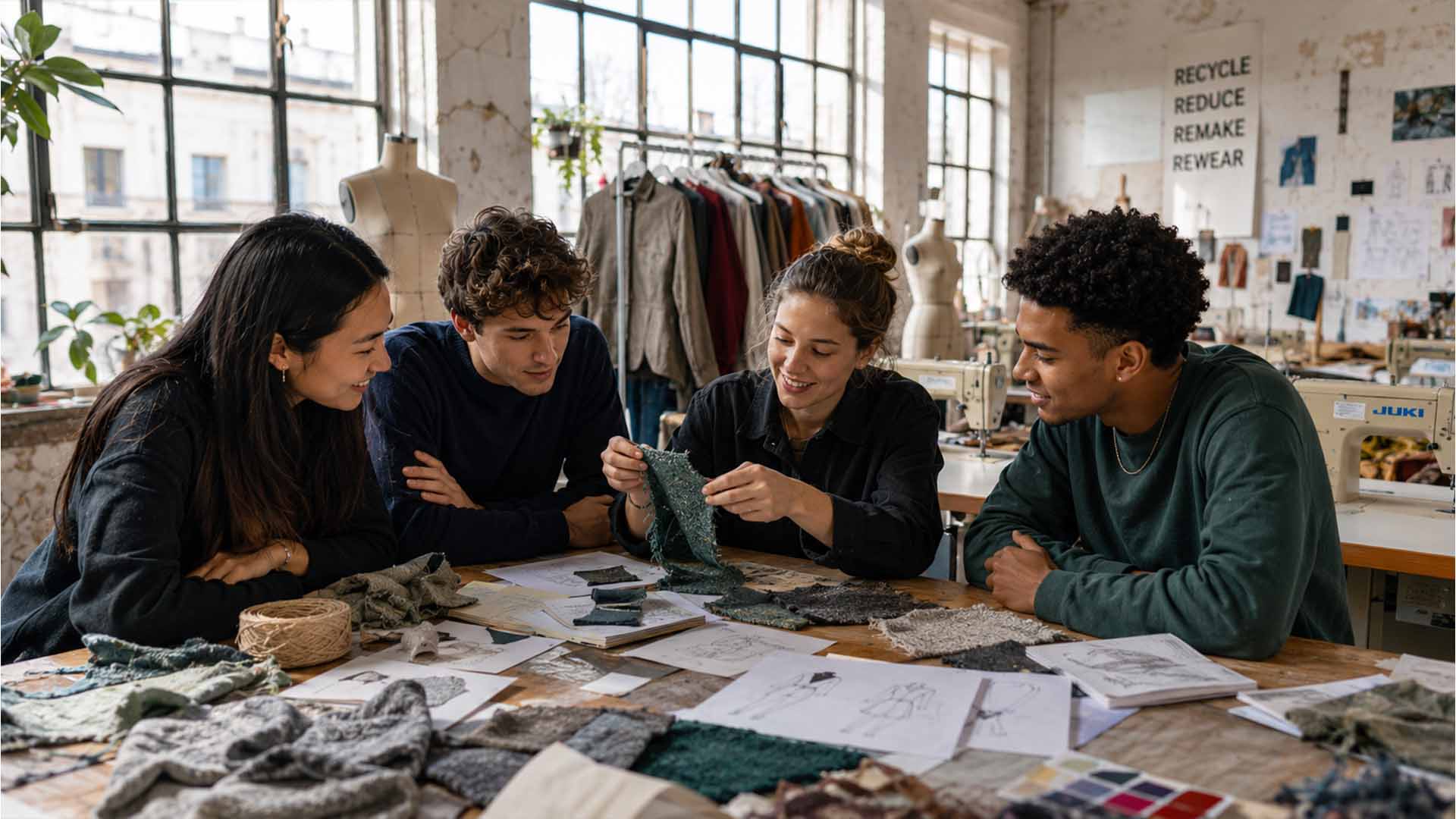
Barcelona, Spain โ€” host city for the Sustainable Fashion: Ethical Design & Production course Barcelona, Spain ยท Where Fast Fashion Meets Slow Innovation
Fashion Design Elective

Sustainable Fashion: Ethical Design & Production

โฑ Total Hours 45
๐ŸŽ“ Credits 3
๐Ÿ“ Location Barcelona, Spain
โœ“ Prerequisites None
๐Ÿ‘—
Primary Discipline
Fashion Design
Suggested Cross Listings Environmental Studies, Business Ethics
Total Hours 45
Credits 3
Prerequisites / Requirements None

Spain has emerged as a significant player in global fashion, with influential fast-fashion giants and innovative sustainable labels that are reshaping the industry's approach to environmental and social responsibility. This course explores how Spanish fashion houses, from major retail groups to independent designers, are adapting to sustainability trends through ethical production, sustainable materials, and eco-conscious consumerism. How are Spanish fashion brands integrating sustainable practices into their business models? What role does Spain's textile manufacturing heritage play in the modern sustainable fashion movement? How do Spanish brands balance growth objectives with increasing demands for transparency and ethical sourcing?

Using Barcelona as both classroom and case study, this course examines the evolving landscape of sustainable fashion in Spain. Through lectures, field visits to fashion headquarters and artisan workshops, and project work, students engage with both theoretical frameworks and practical applications related to sustainable fashion, developing their analytical, research, and problem-solving skills while preparing themselves to engage with the global sustainability agenda in the fashion industry context.
UN Sustainable Development Goals Wheel
Aligned with 5 key UN Sustainable Development Goals

Spain's fashion industry is at a pivotal moment. The course most directly engages SDG 12 (Responsible Consumption and Production), SDG 8 (Decent Work and Economic Growth), SDG 9 (Industry, Innovation and Infrastructure), SDG 5 (Gender Equality) through labor rights, and SDG 13 (Climate Action).

5 Key SDGs Addressed
SDG 5: Gender Equality SDG 8: Decent Work and Economic Growth SDG 9: Industry, Innovation and Infrastructure SDG 12: Responsible Consumption and Production SDG 13: Climate Action
Sustainable fashion trends The role of brands in environmental and social responsibility Materials innovation in fashion Slow fashion vs. fast fashion The impact of textile waste on the environment

By the end of this course, students will be able to:

1
Identify and explain key sustainability principles and human rights considerations in the fashion industry, their historical context, and the evolution of ethical fashion in Spain.
Assessment: Quiz on sustainability frameworks and ethical fashion history.
2
Evaluate the interconnectedness of social, environmental, and economic factors in sustainable fashion, analyzing how interventions in one area impact others (e.g., transparent supply chains' relationship to consumer trust and brand growth).
Assessment: Case study analyzing interdependencies of sustainability factors in the Spanish fashion context.
3
Assess the effectiveness of current sustainability policies and initiatives by Spanish fashion brands, identifying strengths, shortcomings, challenges, and areas for improvement.
Assessment: Research paper critically evaluating sustainability initiatives of a Spanish fashion brand.
4
Design innovative, cross-sectoral solutions that address fashion industry challenges, considering technological, social, and environmental factors within the Spanish context.
Assessment: Group project proposing an innovative solution to a fashion sustainability challenge in Spain.
5
Formulate a compelling sustainability advocacy campaign for a fashion brand, utilizing media, partnerships, and sustainability frameworks relevant to the Spanish and global fashion industry.
Assessment: Presentation and written proposal for a sustainability campaign for a Spanish fashion brand.
20%
Class Discussions and Debates
Demonstrated engagement with assigned readings. Thoughtful contributions to class and Canvas discussions.
All LOs
10%
Quiz
Demonstrated understanding of sustainability frameworks and ethical fashion history.
LO 1
20%
Research Paper
A 10โ€“12-page critical analysis of sustainability initiatives of a Spanish fashion brand. Though not required, comparison with non-Spanish brands is welcome.
LO 3
10%
Case Study
A 3-page analysis of interconnectedness and interdependencies of sustainability factors in the Spanish fashion context.
LO 2
20%
Field Studies
Using class field visits to Barcelona-based fashion headquarters and regional textile workshops, identify and analyze two examples (10% each) of how sustainability theory intersects with real-world fashion industry practices.
LO 3
20%
Group Project and Presentation
Collaborative research on a fashion sustainability issue, solutions, and innovations (10%), and compelling articulation of findings with practical, action-oriented recommendations for a Spanish fashion brand (10%).
LO 4, 5
1
Foundations of Sustainable FashionCore principles, history, and frameworks of sustainable and ethical fashion, with specific focus on Spain's evolution from traditional textile manufacturing to modern sustainability initiatives within the fashion industry.
2
The Spanish Fashion Industry: Past, Present, and FutureHistorical context of Spain's fashion industry, current landscape of Spanish fashion retail groups and designers, and future challenges and opportunities for sustainability in Spanish fashion.
3
Social, Environmental, and Economic Dimensions of Fashion SustainabilitySocial (labor practices, cultural heritage, community impact), environmental (materials, production processes, waste), and economic (business models, profitability, market trends) dimensions of sustainability in the Spanish fashion context.
4
Sustainable Fashion in Practice: Spanish Case StudiesEffectiveness of current policies, programs, and initiatives designed to advance sustainability in Spanish fashion brands (major retail groups, independent designers, textile manufacturers).
5
Measuring Sustainability in Fashion: Certifications and StandardsMethodologies and challenges associated with measuring sustainability in fashion using international standards, certifications, and reporting mechanisms, with focus on how Spanish brands engage with these frameworks.
6
Key Stakeholders in Spain's Sustainable Fashion EcosystemRoles and responsibilities of key stakeholdersโ€”including designers, manufacturers, government agencies, industry associations, educational institutions, consumers, and advocacy groupsโ€”in advancing sustainable fashion in Spain.
7
Ethics and Social Justice in Spanish FashionEthical considerations involved in fashion production and consumption, focusing on issues of labor rights, supply chain transparency, inclusivity, and social responsibility in the Spanish context.
8
Materials Innovation in Spanish FashionInnovative sustainable materials, manufacturing processes, and textile technologies developed by Spanish companies that can reduce environmental impact while maintaining quality and design integrity.
9
Local Production and Global Supply ChainsThe tension between local manufacturing traditions and global supply chains, examining how Spanish fashion balances domestic production with international sourcing while adhering to sustainability standards.
10
The Business of Sustainable Fashion in SpainThe market dynamics surrounding sustainable fashion, including business models, consumer behavior, pricing strategies, and competitive positioning of sustainable Spanish fashion brands.
11
Climate Change and the Fashion IndustryClimate impacts of fashion production and consumption, particularly in Spain's textile regions, and analysis of climate action initiatives by Spanish brands.
12
Communication and Marketing for Sustainable FashionHow to develop effective communication strategies to promote sustainable fashion, avoiding greenwashing while authentically conveying sustainability values to consumers.
13
Fast Fashion Transformation in SpainCritical analysis of Spain's fast fashion giants and their sustainability initiatives, examining the challenges and opportunities in transforming high-volume business models toward greater sustainability.
14
Cultural and Regional Aspects of Sustainable Spanish FashionHow sustainable fashion interacts with Spain's cultural heritage, regional identities, and traditional textile techniques, exploring opportunities to preserve cultural knowledge through sustainable fashion initiatives.
Sustainable fashion studios and showrooms in Barcelona's design districts
Traditional textile workshops and artisan studios in Catalonia
080 Barcelona Fashion Week and sustainable fashion exhibitions
Museu del Disseny de Barcelona and fashion sustainability exhibitions
Textile recycling facilities and circular fashion initiatives in Barcelona
Sustainable fashion retail concepts and eco-concept stores
Using the city as a classroom is an integral element of education abroad, and this course will include several field visits, as well as assignments that prompt students to engage actively with their host context. Field visits vary across terms, but examples include those listed above.
Books Films and Recordings Articles and Reports
Alonso, Leticia, and Patricia San Miguel. 2020. Sostenibilidad en la Moda: Un Modelo para el Futuro. Madrid: ESIC Editorial.
Black, Sandy. 2019. Sustainable Fashion and Textiles: Design Journeys. London: Routledge.
Fletcher, Kate. 2022. Sustainable Fashion and Textiles: Design Journeys. 3rd ed. London: Routledge.
Gรณmez, Elena, and Carlos Miguรฉlez. 2021. Moda Espaรฑola Sostenible: De la Tradiciรณn a la Innovaciรณn. Barcelona: Gustavo Gili.
Martรญnez Barreiro, Ana. 2020. Moda y Sostenibilidad: Paradigmas del Diseรฑo Consciente. Madrid: Catarata.
O'Shea, Covadonga. 2019. Asรญ es Amancio Ortega, el Hombre que Creรณ Zara. Madrid: La Esfera de los Libros.
Posner, Harriet. 2020. Marketing de Moda. Barcelona: Gustavo Gili.
Salcedo, Elena. 2022. Moda ร‰tica para un Futuro Sostenible. Barcelona: Gustavo Gili.
Bardem, Javier, dir. 2019. Santalรณ 205. Documentary on sustainable fashion in Barcelona.
Coixet, Isabel. 2021. Thread by Thread: Spain's Fashion Revolution. Documentary.
Fashion Revolution Spain. 2023. Who Made My Clothes: Spanish Edition. YouTube Video.
Morgan, Andrew. 2015. The True Cost. Documentary featuring perspectives on global fast fashion, including Spanish brands.
Soler, Anna. 2022. Sustainable Barcelona: Fashion Forward. Documentary Series.
Blanco-Gonzรกlez, Alicia, Francisco Dรญez-Martรญn, and Camilo Prado-Romรกn. 2020. "The Relationship between Brand Authenticity, Brand Equity and Sustainability: Analysis of Spanish Fashion Brands." Journal of Product & Brand Management 29 (7): 849-61.
Castellรณ, Araceli, and Del Pino Cristina. 2022. "Beyond Greenwashing: Spanish Fashion Brands' Communication of Sustainability." Journal of Fashion Marketing and Management 26 (2): 375-91.
Dรญaz Soloaga, Paloma, and Teresa Sรกdaba. 2021. "Spanish Fashion Retail and Sustainability: An Analysis of Digital Communications." European Journal of Sustainable Development 10 (1): 321-33.
Martinez, Carolina, and Mรณnica Cortรฉs-Lorenzo. 2023. "Circular Economy Strategies in Spanish Fashion Retail: Case Studies of Transition." Sustainability 15 (2): 1560-78.
Pedraz, Inรฉs, and Jorge Garcรญa. 2022. "Supply Chain Transparency in Spanish Fashion: Assessment of Consumer Awareness and Brand Practices." International Journal of Fashion Studies 9 (1): 68-86.
Sanchez-Vazquez, Rebeca, Arturo Molina-Collado, and รgueda Esteban-Talaya. 2023. "Sustainability Communication in Spanish Fashion Brands: Rhetoric versus Reality." Fashion Theory 27 (4): 502-24.
Zamani, Bahareh, Greg Peters, and Gustav Sandin. 2021. "Life Cycle Assessment of Clothing Libraries: Can Collaborative Consumption Reduce the Environmental Impact of Fast Fashion?" Journal of Cleaner Production 175: 730-39.
Asociaciรณn Moda Sostenible Barcelona. 2023. Manifesto for Barcelona Fashion Sustainability.
Consejo Intertextil Espaรฑol. 2023. Spain's Textile Industry Sustainability Report.
European Commission. 2020. Circular Economy Action Plan.
Greenpeace Spain. 2022. Destintando la Moda: Environmental Impact of Spanish Fashion.
Inditex Group. 2023. Annual Sustainability Report.
Ministerio para la Transiciรณn Ecolรณgica. 2023. Spanish Strategy for Circular Economy in the Textile Sector.
United Nations. 2018. Fashion Industry Charter for Climate Action.