Circular Economy: Local Practices and Global Implications โ€” Florence, Italy Florence, Italy ยท From Linear to Circular
Economics Florence Elective

Circular Economy: Local Practices and Global Implications

โฑ Total Hours 45
๐ŸŽ“ Credits 3
๐Ÿ“ Location Florence, Italy
โœ“ Prerequisites None
โ™ป๏ธ
Primary Discipline
Economics
Suggested Cross Listings Environmental Studies, Business Political Science
Total Hours 45
Credits 3
Prerequisites / Requirements None

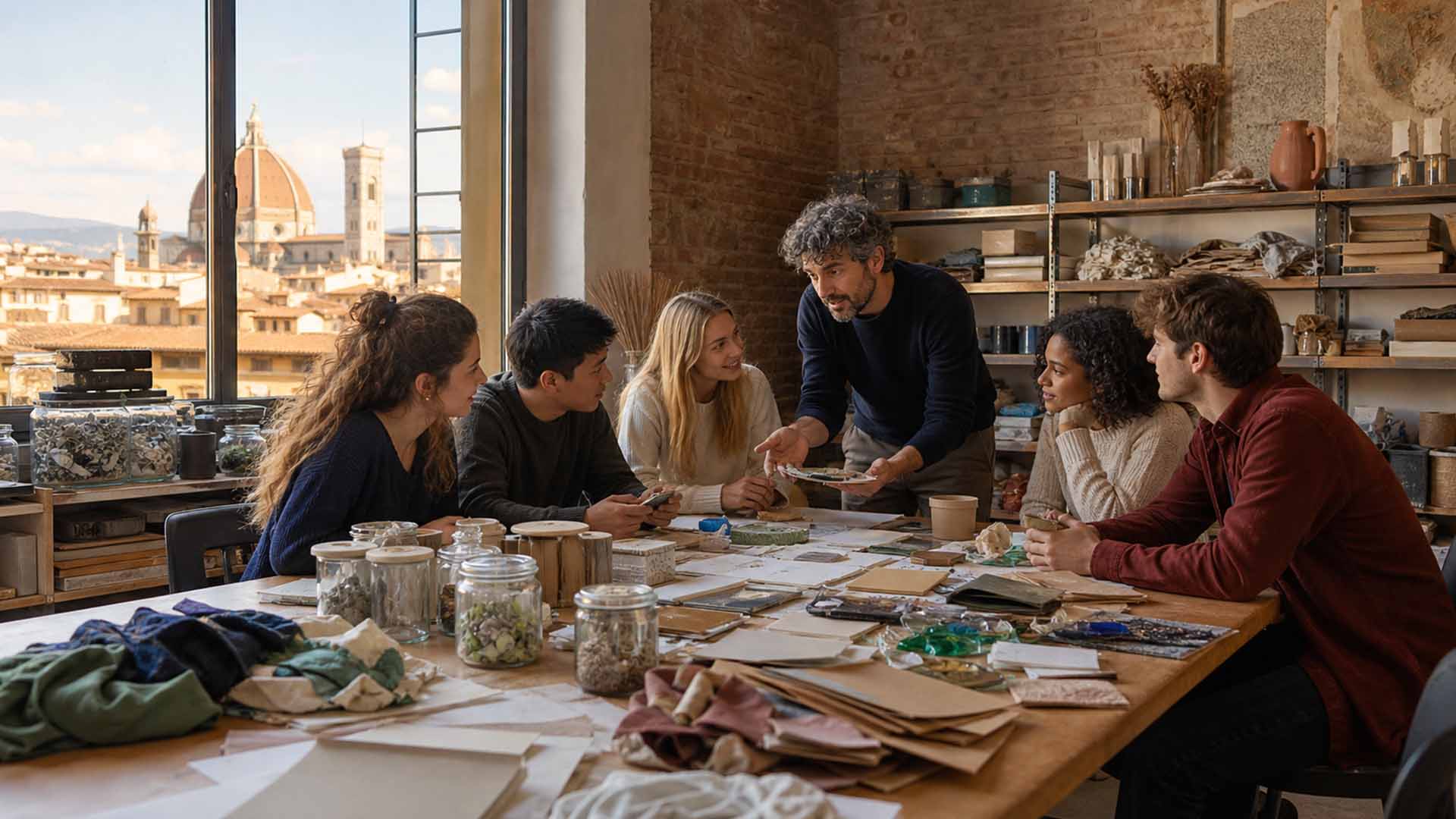
This course explores the principles and applications of the circular economy, emphasizing Italyโ€™s innovative approaches to sustainable production and consumption. While grounded in economic and environmental theory, the course focuses on real-world case studies from across Italyโ€”particularly Florence and the Tuscany region, which are rapidly becoming laboratories of circular innovation in areas such as textiles, food systems, and design. Students will investigate how local and national efforts in circularity are shaping broader conversations around sustainability, policy, design, and business transformation. Emphasis is placed on systemic thinking, life-cycle analysis, and the economic, social, and ecological implications of circular models. Florenceโ€™s legacy in artisanal craftsmanship and contemporary sustainable fashion provides a compelling environment to explore local solutions with global relevance.
UN Sustainable Development Goals Wheel
Closing the loop: from take-make-dispose to circular

The circular economy is the operational engine of SDG 12 (Responsible Consumption & Production). The course also advances SDG 8 (Decent Work) through new green-economy jobs, SDG 9 (Industry, Innovation & Infrastructure) via product redesign and material flows, SDG 11 (Sustainable Cities) in urban metabolism, and SDG 13 (Climate Action) by reducing extractive emissions.

5 Key SDGs Addressed
SDG 8: Decent Work and Economic Growth SDG 9: Industry, Innovation and Infrastructure SDG 11: Sustainable Cities and Communities SDG 12: Responsible Consumption and Production SDG 13: Climate Action
Introduction to the circular economy model Case studies of circular economy initiatives (e.g., fashion, plastic recycling) The role of design in circular product development Circular economy in the food and beverage sectors Policy frameworks for promoting circularity

By the end of this course, students will be able to:

1
Define the core concepts of the circular economy and contrast them with linear economic models.
Assessment: Quiz on Circular Economy Foundations.
2
Evaluate circular economy initiatives in Italy, with attention to local context, stakeholder engagement, and environmental outcomes.
Assessment: Case Study Analysis.
3
Analyze the role of policy, regulation, and design in shaping the circular economy at local and national levels in Italy.
Assessment: Research Paper.
4
Design a circular solution for a specific product, service, or urban challenge, incorporating life-cycle analysis, user behavior, and business models.
Assessment: Class Participation and Discussion.
5
Articulate the global relevance of local circular economy practices, linking Italian efforts to international frameworks like the SDGs and EU Green Deal.
Assessment: Class Participation and Discussion.
20%
Class Participation and Discussion
Based on engagement with readings, guest lectures, and site visits. Emphasis on thoughtful questions and contributions.
All LOs
10%
Quiz on Circular Economy Foundations
Assessing understanding of core concepts and historical evolution of circular economy thinking.
LO 1
10%
Case Study Analysis
A 3-page analysis of a circular economy initiative in Italy, evaluating its design, implementation, and outcomes.
LO 2
20%
Research Paper
A 10โ€“12-page critical paper on a specific industry, product system, or policy influencing circular practices in Italy.
LO 3
20%
Fieldwork Reports
Two short (3-page) reports based on site visits, evaluating how businesses or institutions apply circular strategies. [LO2, LO3]
All LOs
20%
Group Project & Presentation
Collaborative project proposing a circular solution. Includes oral presentation and submission of visual materials or prototypes. [LO4, LO5]
All LOs

The course moves from the foundations of circular thinking through industrial design, business models, regional case studies, and the policy frameworks driving Europe's circular transition.

1
Introduction to the Circular EconomyOrigins, principles, and global significance of the circular economy. Introduces systems thinking, the waste hierarchy, and closed-loop concepts.
2
Linear vs. Circular: Rethinking Resource FlowsTraditional linear model of production and consumption versus circular alternatives, emphasizing environmental and economic impacts.
3
Italyโ€™s Circular Shift: National Strategies and EU PolicyItalyโ€™s national roadmap for circularity and its alignment with the European Unionโ€™s Green Deal and Circular Economy Action Plan.
4
Florence as Living Lab: Circularity in Urban PracticeFlorenceโ€™s role circular innovation initiatives in urban planning, smart waste systems, and local governance.
5
Circular Design ThinkingProduct and service design through a circular lens, emphasizing material recovery, modularity, and user-centered sustainability.
6
The Role of Policy and RegulationHow law and policy shape circular transitions, including public procurement, tax incentives, and extended producer responsibility (EPR).
7
Fashion, Textiles, and the Circular EconomyItalyโ€™s leadership in sustainable fashion with a focus on textile reuse, circular business models, and consumer behavior change.
8
Food Systems and CircularityInnovations in reducing food waste, composting, urban agriculture, and circularity in hospitality and supply chains.
9
Technology, Innovation, and MeasurementHow digital tools like blockchain, IoT, and lifecycle analysis support transparency, traceability, and metrics for circularity.
10
Student Presentations: Circular Innovation ProjectsGroups present their proposed circular solutions, showcasing feasibility, stakeholder analysis, and environmental/social impact.
11
Local to Global: Linking to the SDGs and Global FrameworksSynthesis of course learnings by connecting local circular efforts in Italy to the UN SDGs, global trade, and planetary boundaries.
A recycling or circular materials innovation center in or near Florence
A circular fashion studio or textile upcycling workshop
A farm-to-table restaurant, biodynamic vineyard, or food rescue nonprofit promoting zero-waste practices
Sustainability officers from local government and regional environmental agencies
Artisans and entrepreneurs practicing circular craft and design
Policy experts and researchers from institutions such as the University of Florence and ARRR (Regional Agency for Resources Recovery)
Class field visits and guest lectures are required academic components and contribute to participation and engagement grades.
Using the city as a classroom is an integral element of education abroad, and this course will include several field visits as well as assignments that prompt students to engage actively with their host context. Field visits may include (final list will be provided in the term syllabus):
Books Journal Articles Websites & Reports Multimedia
Braungart, M., & McDonough, W. (2002). Cradle to cradle: Remaking the way we make things. North Point Press.
Esposito, M., Tse, T., & Soufani, K. (2018). The circular economy: A wealth of opportunities. Pearson.
Kirchherr, J. (Ed.). (2021). Circular economy and sustainability (Vol. 1). Springer.
Raworth, K. (2017). Doughnut economics. Chelsea Green.
Stahel, W. R. (2019). The circular economy: A userโ€™s guide. Routledge.
Webster, K. (2017). The circular economy: A wealth of flows. Ellen MacArthur Foundation.
Bocken, N. M. P., de Pauw, I., Bakker, C., & van der Grinten, B. (2016). Product design and business model strategies for a circular economy. Journal of Industrial and Production Engineering, 33(5), 308โ€“320.
Kirchherr, J., Reike, D., & Hekkert, M. (2017). Conceptualizing the circular economy: An analysis of 114 definitions. Resources, Conservation & Recycling, 127, 221โ€“232.
Marin, D., & Lotti, G. (2020). The Italian model of circularity: Between innovation and tradition. Circular Economy Journal, 1(1), Article 100001.
Rizos, V., Tuokko, K., & Behrens, A. (2016). Circular economy in SMEs: Obstacles and enablers. Sustainability, 8(11), 1212.
ARPA Toscana. (n.d.). Environmental reports and waste management. https://www.arpat.toscana.it/
Ellen MacArthur Foundation. (n.d.). Circular economy resources and frameworks. https://ellenmacarthurfoundation.org/
ENEA. (n.d.). Circular economy reports. https://www.enea.it/
European Commission. (2020). Circular economy action plan. https://ec.europa.eu/environment/circular-economy/
Italian Circular Economy Stakeholder Platform. (n.d.). Resources and initiatives. https://circulareconomyitaly.it/
Circularity.com. (n.d.). Italian circular economy hub. https://circularity.com/
Ellen MacArthur Foundation. (2012). Re-thinking progress: The circular economy [Video]. YouTube. https://www.youtube.com/watch?v=R7jw__TbVdE
UNIDO. (n.d.). Italyโ€™s circular economy in practice [Video]. YouTube.
DW Documentary. (n.d.). Circular economy: Redesigning the future [Documentary].
Vogue Business. (n.d.). The future of Italian fashion is circular [Short documentary].
Treggiden, K. (Host). (n.d.). Circular [Podcast].
Acaroglu, L. (2013). How the circular economy can help save the world [TEDx Talk]. TED Conferences. https://www.ted.com/talks/leyla_acaroglu_how_the_circular_economy_can_help_save_the_world